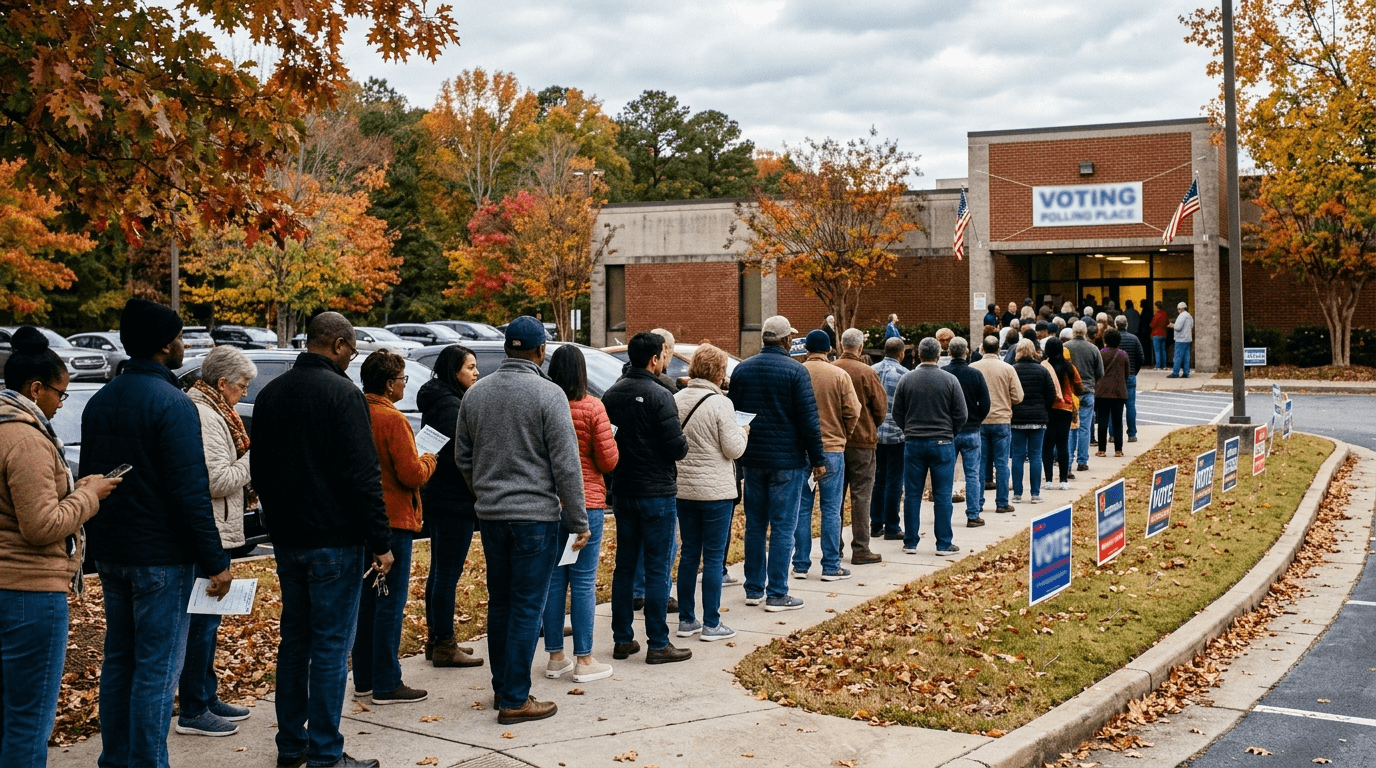
Georgia voters are choosing a governor alongside statewide, legislative, local and other contests, according to the state. The general election is scheduled for November 3, and advance in-person voting is scheduled to end October 30. A recent poll shows a close governor’s race, but neither that survey nor a prediction market establishes the result or the margin voters will deliver. The distinction matters: a poll describes responses from its surveyed voters, while market prices describe what traders currently believe about specified outcomes.
An InsiderAdvantage survey conducted after the latest gubernatorial debate showed Jackson narrowly ahead of Bottoms, 49% to 47%, with some voters undecided, according to WSB-TV. That is a snapshot, not an election result. The supplied reporting does not provide the survey’s sample size, field dates, likely-voter screen or margin of error, so the reported gap should not be treated as a settled lead. The information here also does not show how the finding compares with other recent polls. It supports describing a close contest, not claiming that the eventual outcome or margin is known.
On Polymarket, traders put the Republican candidate’s chance of winning by a margin of three to six points at 22% as of 11:59 a.m. ET on Oct. 19. The Republican zero-to-three-point margin band is at 28%. For the Democratic candidate, the zero-to-three-point, three-to-six-point and six-to-nine-point bands are at 19%, 14% and 10%, respectively. These prices are trader beliefs about particular outcomes, not objective probabilities or a forecast. The listed bands do not, by themselves, establish a complete account of every possible result. A price for one margin range should not be mistaken for a direct measure of who will win overall.
The supplied market data show no movement in the quoted legs over either the past day or the past week. Trading is uneven across the listed outcomes: the Republican zero-to-three-point band recorded $696 in trading over the last day, while several other margin bands have no trading on record. That limits what those prices can tell readers about the breadth of market opinion. The separate winner contracts for Person A and “Other” each show $0 in trading over the last day in trading over the last day, so their displayed prices come with no recorded trading in that period. The packet supplies no cross-venue confirmation; the market figures therefore remain one venue’s view, rather than a comparison across markets.
The poll report describes competing turnout signals. The pollster characterized support among senior voters as strong, while also citing strong African American turnout on the first day of early voting. The pollster’s chairman said Jackson’s absence from the debate appeared to have had no effect on the survey; that is the pollster’s interpretation, not proof of causation. These claims do not resolve how turnout will develop or how voters will choose. The poll and the market leave the central question open: how the vote will break, and by what margin. The most useful reading is a close contest still in doubt, not a confident prediction of its outcome.