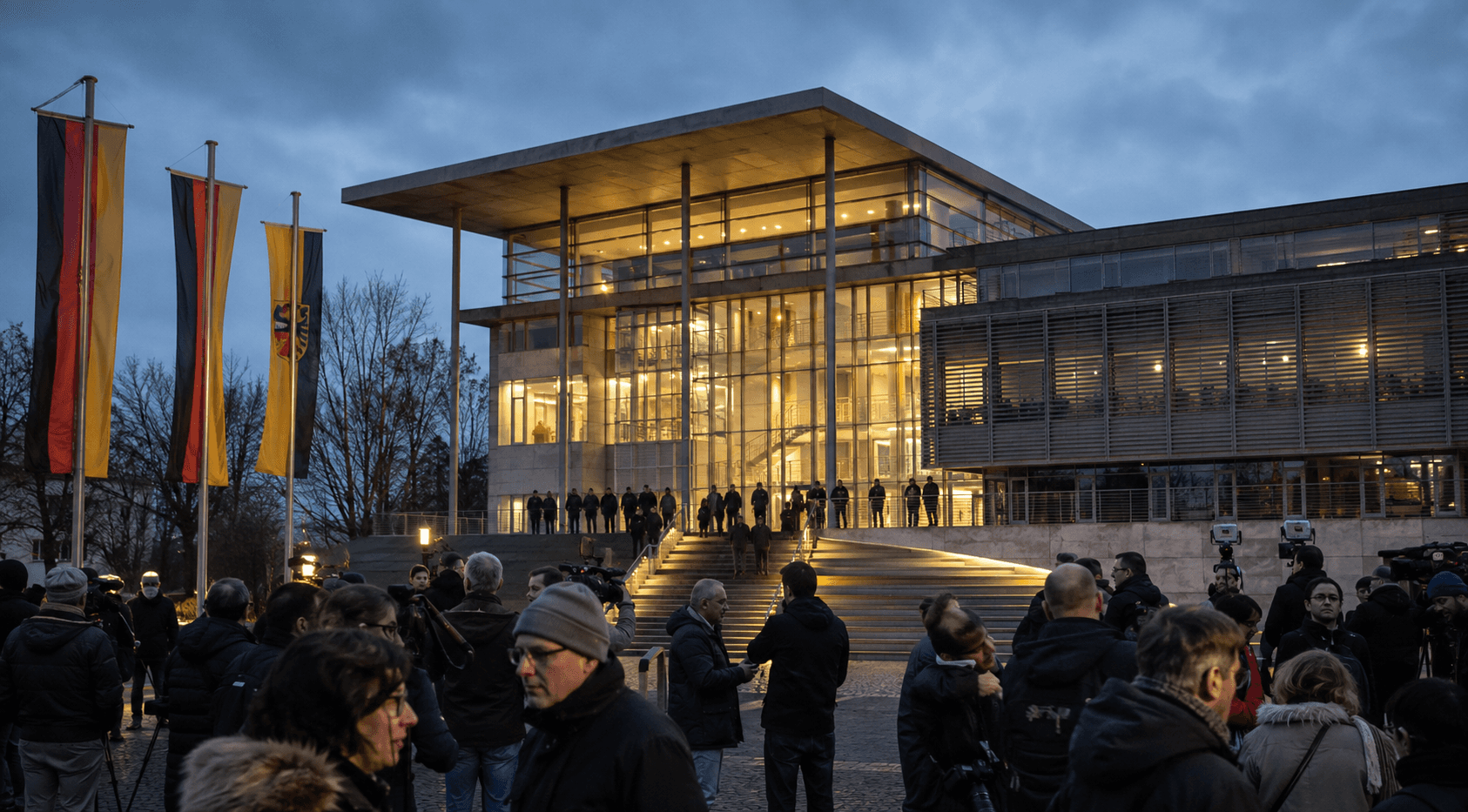
Alternative for Germany won a commanding victory in Saxony-Anhalt on Sunday, transforming a regional election into the sharpest test yet of Germany's effort to keep the far right out of executive power. Official preliminary results put AfD at 43.8 percent of the second vote, more than double its 2021 share, while Chancellor Friedrich Merz's Christian Democrats fell to 17.2 percent after leading the state government for twenty-four years. Turnout reached 77.8 percent, giving the result unusual democratic weight rather than the appearance of a protest victory produced by apathy. AfD finished with 39 of the new parliament's 83 seats, an extraordinary result but three short of the majority its lead candidate Ulrich Siegmund would need to become state premier without outside support.
The result lands heavily on Merz, who entered national office promising to reverse AfD's advance. Instead, his party lost roughly half its support in a state long governed by the center right, while AfD recorded its strongest performance in any German state election. Germany's history has made cooperation with extremist movements uniquely sensitive, and the mainstream parties have maintained a political firewall against governing with AfD. That line held after AfD won in neighboring Thuringia two years ago, but Saxony-Anhalt is a harder case because Siegmund stands much closer to an outright majority and is openly seeking votes from rival lawmakers. Other German state contests later this month will now unfold under pressure from a result that could energize AfD well beyond the east.
Prediction-market prices moved decisively with the count. Polymarket's bracket for an AfD vote share between 42 and 45 percent rose about 29.5 percentage points over the latest twenty-four-hour period and was effectively at certainty Monday afternoon, consistent with the 43.8 percent result. The parent group had recorded about $375,000 in total activity, including nearly $90,000 over twenty-four hours. That pricing does not decide who governs; it reflects that the vote-share question is settled while the political outcome remains open.
The immediate struggle now shifts from voters to coalition talks. The left-populist BSW cleared the threshold with 5.3 percent and shares AfD's Russia-friendly outlook and restrictive approach to immigration, but the two parties diverge elsewhere. BSW officials have floated support for a nonpartisan premier, while Siegmund insists that AfD received a mandate to lead. Excluding AfD could require an unwieldy five-party arrangement spanning the Christian Democrats, Social Democrats, Greens, the Left and BSW. Merz reiterated Monday that his party would not cooperate with AfD. The next days will show whether that firewall can survive a result that leaves almost every alternative coalition dependent on ideological rivals, or whether defections and parliamentary bargaining finally give AfD the state power it has never held.