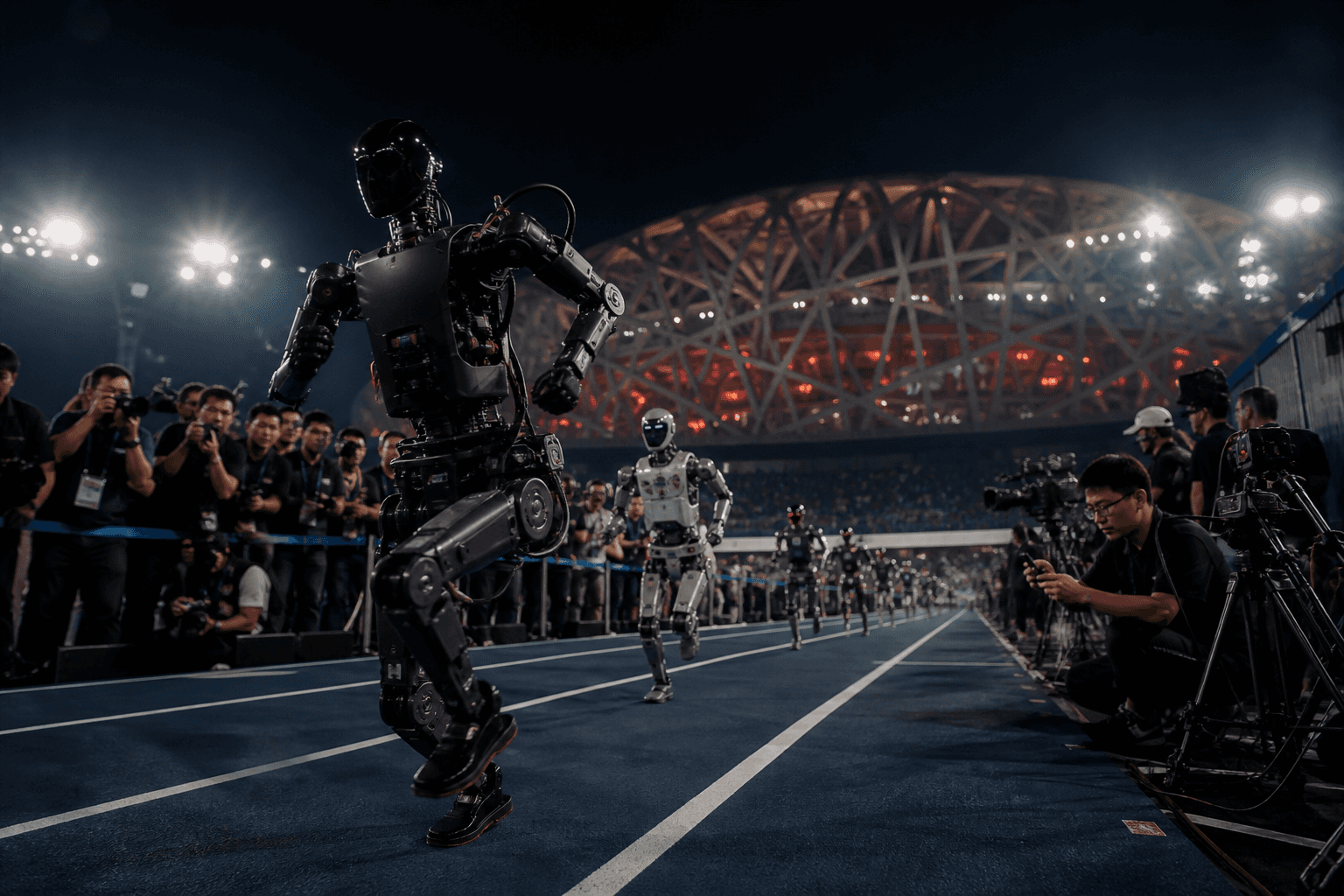
China's World Humanoid Robot Games have become the kind of event that feels easy to dismiss as theater right up until the machines start outrunning the comparisons built for them. This year's edition in Beijing opened with humanoid robots posting sprint and jump marks that organizers said topped famous human records, turning an Olympics-style showcase into a global demonstration of just how far Chinese robotics has advanced in public view. The spectacle mattered because it did more than entertain. It gave China another chance to frame humanoid robotics as a national capability race, one that blends artificial intelligence, manufacturing and industrial policy into a single message for domestic investors, overseas competitors and potential buyers watching for signs that the field is moving beyond carefully staged lab clips.
The setting around the games made that message even louder. The robot competition arrived alongside the World Robot Conference in Beijing, where Chinese companies filled exhibition halls with factory bots, service machines and increasingly polished humanoid systems aimed at everything from logistics to elder care. Recent investor enthusiasm has already shown how hungry markets are for a believable robotics growth story, with Unitree's Shanghai debut adding fresh heat to the sector just as officials and executives were trying to sell the idea that China can dominate not only the production of humanoids but the supply chains and deployment ecosystems around them. For companies chasing that future, the games served as a live marketing stage where speed, stability and visual polish all counted as signals of engineering progress.
That does not mean the robots are suddenly ready for everyday life, and the reporting from Beijing made that limit impossible to ignore. Even as some machines posted eye-catching times, others crashed into walls, stumbled after races or needed human support once the cameras moved in close. Those failures are part of the story rather than a contradiction of it. They show how much of the humanoid push still lives in the gap between headline-grabbing demonstrations and dependable commercial use. Beijing seems comfortable with that tension. The government and the companies involved appear to be betting that public proof of rapid iteration matters more right now than pretending the hardware is already mature. In that sense, the games are less a victory lap than a pressure test held in front of the world.
Prediction markets are still far more cautious about what comes next than the pageantry in Beijing might suggest. On Polymarket, a live market on whether Tesla will release Optimus to the general public by the end of this year was sitting around four percent on Tuesday, a sign that traders still see true consumer-grade humanoid deployment as distant even after another week of eye-catching robot headlines. That disconnect helps explain why the Beijing games matter. They are not evidence that the commercial race has been won. They are evidence that China wants to own the narrative around who is moving fastest, who can scale hardware fastest and who gets to define the next stage of humanoid development. If that effort keeps producing better machines, cheaper manufacturing and stronger investor backing, the padded walls in Beijing may one day look less like comic relief and more like an early marker on the road to a very serious industry.