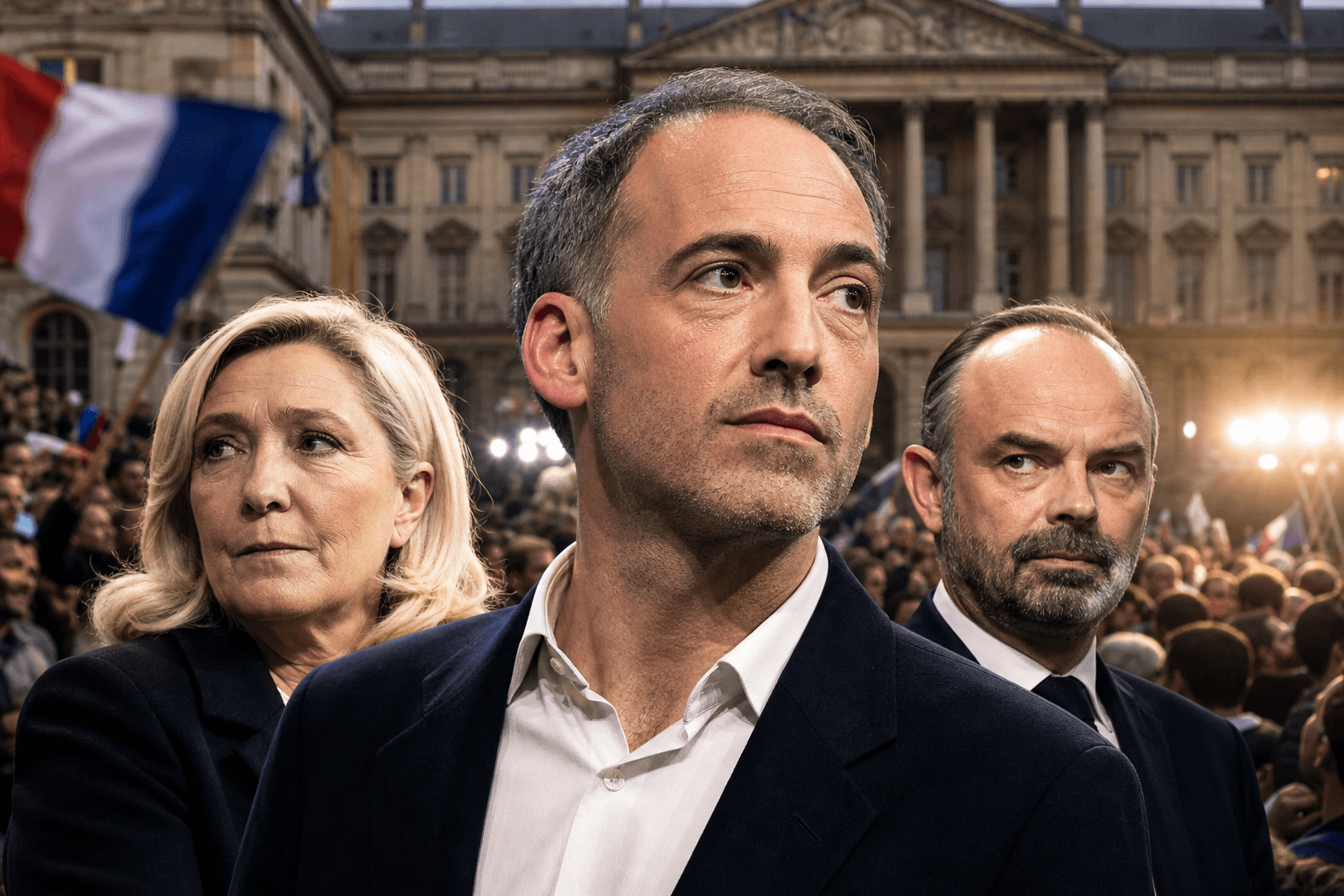
France's next presidential race already looked volatile before Raphaël Glucksmann formally entered it. His decision on Sunday, August 23, to run has now added another serious contender to an election that was already pulling the center and the left in too many directions at once. That matters because Marine Le Pen remains the dominant figure in the field, and because every new candidacy is judged less on whether it can simply make noise than on whether it can prevent the anti-Le Pen vote from fragmenting again. Glucksmann is not arriving as a novelty candidate. He is trying to turn his European profile, his pro-Ukraine politics and his claim to represent a modern pro-European left into a national campaign at a moment when voters are still deciding whether the election will become a duel between the nationalist right and a bruised establishment center.
His entry lands in a field that already contains obvious rivals and unresolved alliances. Le Pen's decision to run again has kept the far right at the center of the contest, while former prime minister Édouard Philippe still occupies a leading place among voters looking for a mainstream alternative. Jean-Luc Mélenchon remains a force on the hard left, but he is also a polarizing figure who makes unity difficult for anyone hoping to assemble a broader coalition. Glucksmann's pitch is that he can do something different: speak to left-leaning voters who want social protection and a harder line on national sovereignty without accepting either Le Pen's nationalism or Mélenchon's confrontational style. That is a narrow path, and in France's two-round system it becomes even narrower when several camps try to claim the same anti-extremes ground at once.
The deeper question is not simply whether Glucksmann can rise from the lower end of the field. It is whether his candidacy changes how the entire race is organized. France is heading toward an election shaped by purchasing power, immigration, defense, debt and the country's place in Europe, but it is also heading toward a campaign in which personality and coalition discipline may matter just as much. Glucksmann's supporters see room for a candidate who sounds serious about institutions and security without sounding exhausted or managerial. Skeptics see one more entrant dividing an electorate that still has not chosen a clear answer to Le Pen. Even the media environment has adjusted quickly: Léa Salamé, one of France's best-known television anchors and Glucksmann's partner, said she would step back from political broadcasting, a sign that his candidacy is being treated as a genuine national campaign rather than a symbolic bid.
Prediction markets are reflecting that imbalance between momentum and scale. Polymarket still places Le Pen in front and Philippe as the nearest alternative, while Glucksmann remains a long way behind the leading tier despite the burst of attention around his launch. That says less about the final result than about the current shape of the race: a new candidacy has changed the conversation, but it has not yet changed the hierarchy. The next decisive tests are closer than the election itself. Autumn polling, the struggle over who leads the broader left, and the question of whether centrist and center-left voters can rally around fewer names will determine whether Glucksmann has truly widened the race or simply made a crowded contest even harder to untangle.