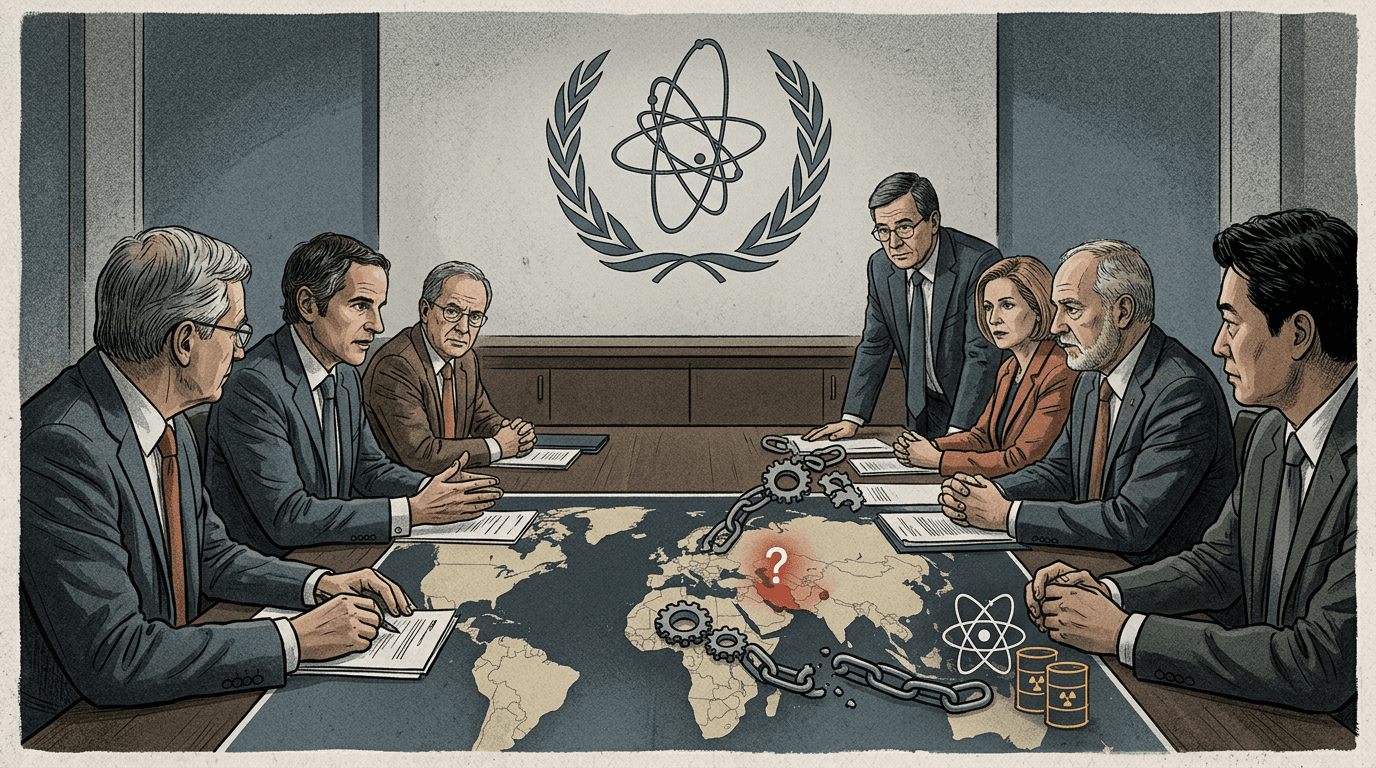
The International Atomic Energy Agency Board of Governors adopted a resolution on 10 June 2026 expressing grave concern that it has been unable to verify Iran's declared nuclear material for nearly a year, calling the gap 'a matter of proliferation concern.' The resolution, passed during the Board's 1812th session, demands that Iran urgently provide complete information and access to resolve the verification deadlock.
Before the US-Israeli military strikes on 28 February 2026, Iran held a total enriched uranium stockpile of 9,874.9 kg, including 440.9 kg at 60% purity — material that, if further enriched to weapons grade, could theoretically be sufficient for up to 10 nuclear bombs, according to BBC reporting citing the IAEA. The strikes damaged seven declared nuclear facilities, including the enrichment plants at Natanz and Fordow, crippling Iran's known enrichment infrastructure.
IAEA inspectors have not been granted access to any declared enrichment sites since February 2021. The agency conducted an inspection at the Bushehr Nuclear Power Plant on 1-3 June 2026 with Iran's cooperation, but that remains the only facility visit in over five years. IAEA Director General Rafael Grossi said on 24 June 2026 that inspectors would visit Iranian nuclear sites under the preliminary US-Iran peace agreement, which provides for on-site IAEA-supervised dilution of Iran's highly enriched uranium.
The peace deal, signed in June 2026, calls for the downblending of Iran's near-weapons-grade stockpile, but implementation has not been verified. No public evidence of nuclear test site preparation or seismic anomalies has been reported, and Iran has not declared any intention to conduct a test. The core uncertainty remains whether Iran can reconstitute enrichment capability at damaged or undeclared locations without detection, given the prolonged verification gap.
The next phase hinges on whether IAEA inspectors gain access to the bombed enrichment sites and whether the peace agreement's downblending proceeds under credible monitoring. Any verified progress on access or stockpile reduction would reduce the potential for a covert nuclear test, while continued limits on international scrutiny sustain the uncertainty.