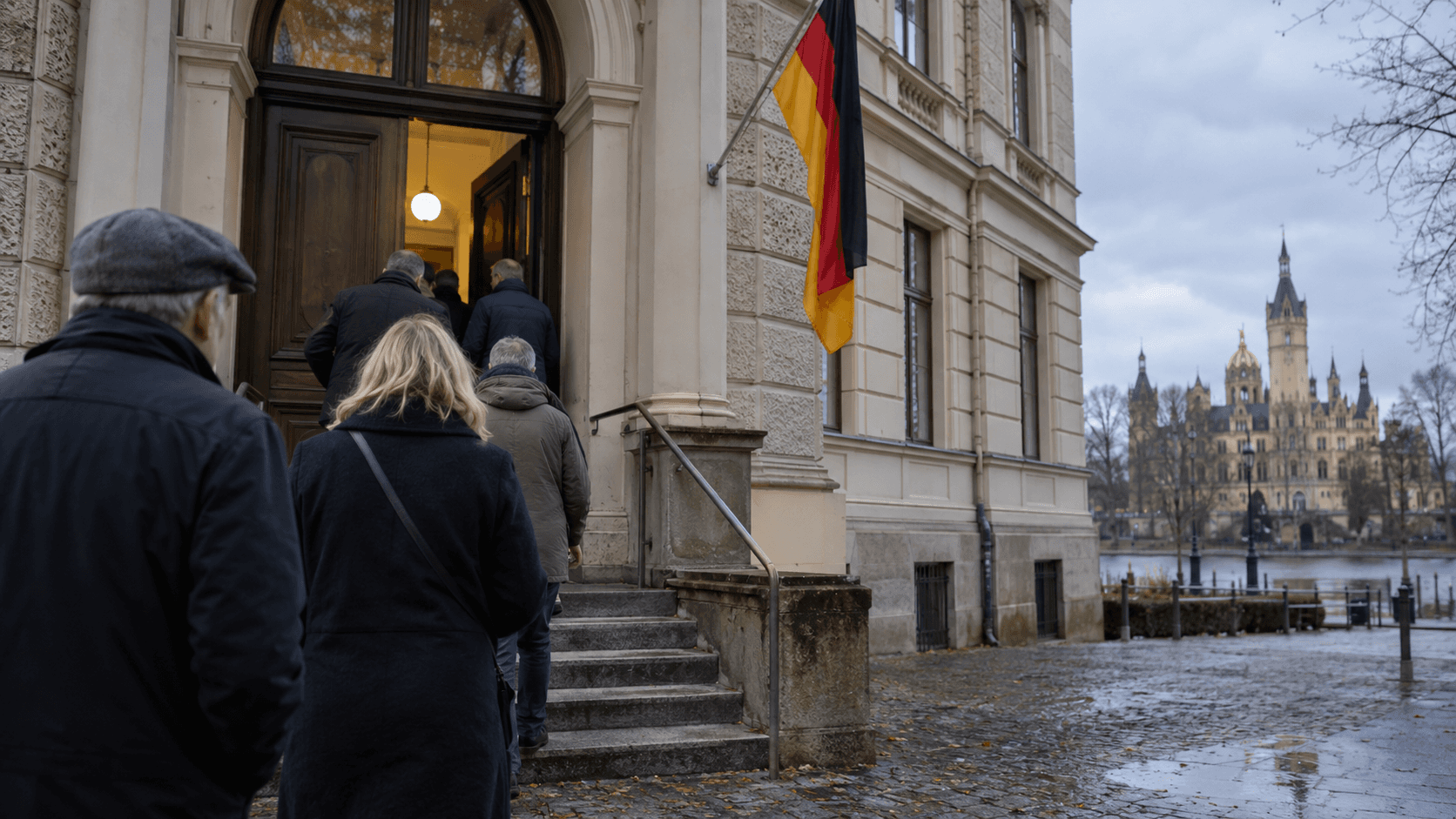
Voters in Mecklenburg-Western Pomerania went to the polls Sunday in a state election that will test whether the Social Democrats can hold power against a strengthened Alternative for Germany. The northeastern region is choosing a new parliament while Berlin holds its own state election on the same day. In Mecklenburg-Western Pomerania, the central contest is between the SPD of minister-president Manuela Schwesig and the far-right AfD. The result will determine the next governing coalition in the state and offer a measure of the AfD's reach after its strong showing in neighboring Saxony-Anhalt earlier this month. No result was available when voting began.
The state's parliament confirms that the election is being held on September twentieth and says first projections will be available after polls close at six in the evening local time. Later counts will determine the official seat allocation. That timetable matters because a narrow lead in pre-election surveys does not settle either the winner or the coalition arithmetic. Parties near the threshold for entering parliament can change the balance among larger groups. Voters are choosing representatives for a regional government with direct responsibility for state policy, even as the race is being read nationally as a signal about Germany's political direction.
Schwesig has led the state since twenty seventeen and remains the SPD's main asset in a difficult eastern German landscape. The AfD enters the vote after an electoral breakthrough in Saxony-Anhalt, hoping to turn a larger vote share into a path to power. Euronews reported that the SPD and AfD were the main rivals in Mecklenburg-Western Pomerania, while Chancellor Friedrich Merz's Christian Democrats were close to the five-percent threshold required to enter the state parliament. A poor CDU result would add to pressure on Merz, but the state outcome alone would not change the federal government. Coalition negotiations and the distribution of seats will matter as much as which party finishes first.
Prediction-market trading shows uncertainty about the SPD's eventual seat total, rather than a known election result. In a Polymarket group on the party's seats, a range of twenty-six to twenty-nine stood near fifty-two percent Sunday morning; thirty to thirty-three seats stood near thirty-nine percent. The latter outcome had risen about eighteen percentage points over the preceding day and appeared among the site's largest movers. These are prices on alternative seat brackets, not vote shares or official projections. They may change rapidly as voting proceeds, and the final count may fall outside either leading range.
Election officials will release the first projections after polls close, followed by more complete tabulations and an official result. Those figures should establish whether the SPD can stay ahead, how far the AfD has advanced, and whether smaller parties clear the threshold. The governing question will then move to which parties can form a majority under Germany's state parliamentary system. For Merz, the political fallout will depend especially on the CDU's showing in both Mecklenburg-Western Pomerania and Berlin. For residents of the Baltic state, the more immediate consequence is who can build a workable government once the ballots have been counted.