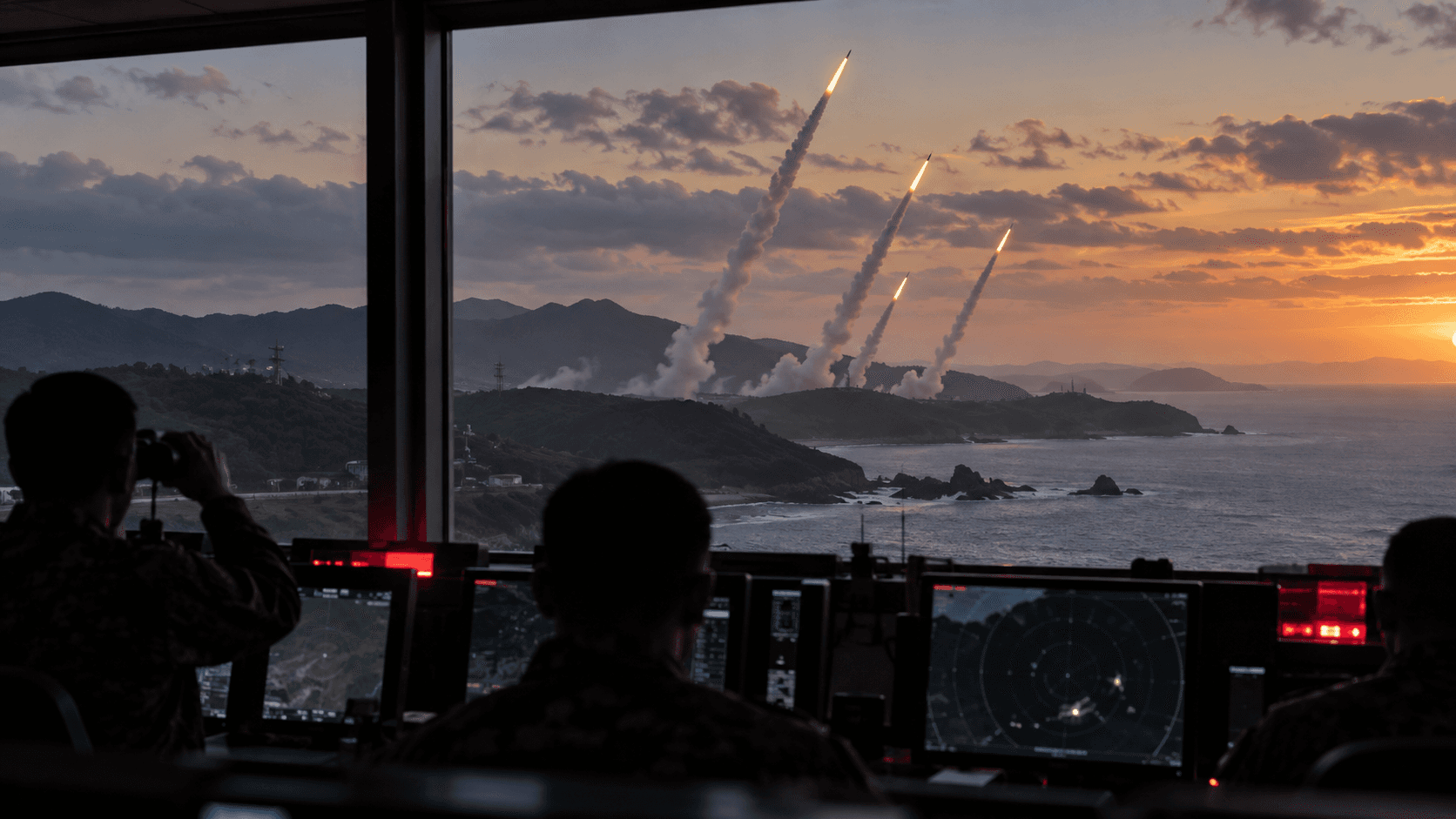
North Korea launched several short-range ballistic missiles from its eastern coast on Saturday, renewing a cycle of weapons tests and military exercises around the Korean Peninsula. South Korea's Joint Chiefs of Staff said the missiles were fired at about 5:20 a.m. from the Wonsan area and traveled roughly 250 kilometers toward the East Sea. Seoul raised its surveillance posture and shared tracking information with Washington and Tokyo as South Korean and American specialists began analyzing radar data. KBS reported that the projectiles appeared to fly toward mock targets on an island, while officials had not yet publicly identified an exact missile model. The launch was the clearest new military signal from Pyongyang in several weeks.
The timing made the political message difficult to miss. The United States, South Korea and Japan had completed the five-day Freedom Edge exercise on Friday, training across air, sea and cyber domains in waters near the Korean Peninsula. North Korean Defense Minister Kim Song Gi had denounced the drills as a rehearsal for war and warned of a forceful response. Yonhap said Saturday's launch followed the end of those exercises and preceded an expected meeting between President Donald Trump and Chinese President Xi Jinping later in the month. Seoul's presidential National Security Office convened an emergency meeting and urged the North to stop launches that violate United Nations Security Council resolutions.
The launch also transformed expectations around September's testing pace. A Polymarket event tracking the number of calendar days on which North Korea fires qualifying missiles gave the single-test outcome about a 46% chance and the two-test outcome about 34% in the Saturday snapshot. The contract for no September test dropped nearly 24 percentage points in one day to roughly 3%. Those figures describe traders' assessment of the remaining month; they do not measure the military effectiveness of the missiles or establish Pyongyang's political intent. Another launch on a separate day would move the event into a different outcome under its published rules.
The episode adds pressure to an already narrow diplomatic opening. Pyongyang has continued expanding its missile and naval capabilities while deepening ties with Russia and China and demanding recognition as a nuclear state. Allied governments face a familiar dilemma: exercises designed to improve deterrence can also provide North Korea with a pretext for another demonstration, while reducing drills has not reliably produced restraint. The immediate questions are whether North Korean state media identifies the weapons and whether Saturday begins a sequence of launches rather than a single response. The relatively short flight distance points to a regional military message, but the timing gives it wider diplomatic importance. Any follow-on test before the anticipated Trump-Xi meeting could further complicate attempts to put North Korea back on a negotiating agenda.