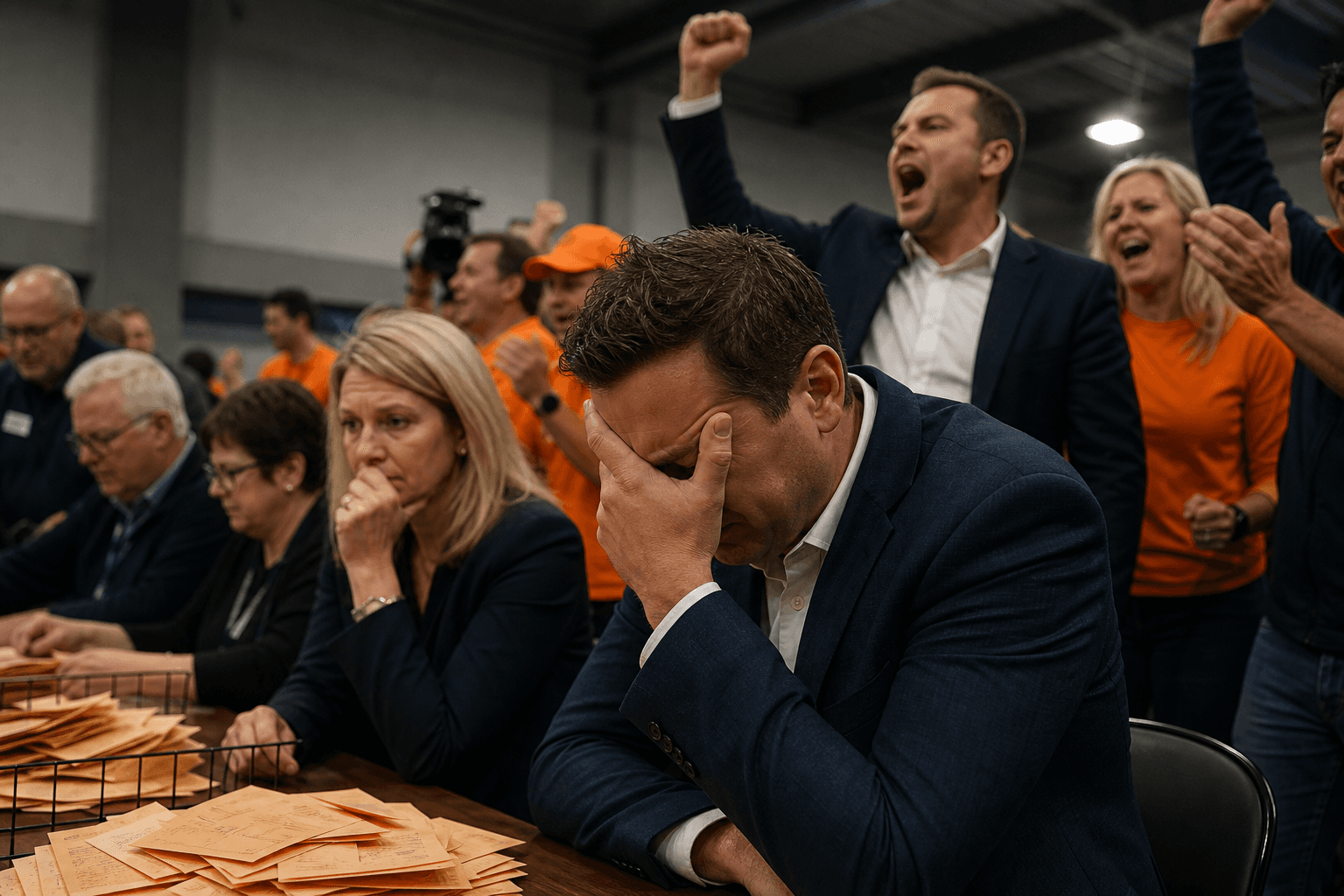
Western Australia's Secret Harbour by-election turned into something larger than a local replacement race on August 29. By late evening in Perth, One Nation's Luke Herdegen had claimed victory in a seat Labor had treated as dependable territory for decades, giving Pauline Hanson's party its first lower house seat in the state. The result mattered not simply because Labor lost a district vacated by veteran minister Paul Papalia, but because it happened in an outer suburban electorate where cost-of-living frustration, housing pressure and political resentment have been building for months. A contest that began as a routine test of whether Labor could hold a friendly patch of ground instead became a warning that anger in the suburbs is moving in directions the major parties do not fully control.
The scale of the shock is what gives the result national relevance. ABC's election coverage showed Herdegen leading Georgia Tree by a decisive margin on the preference count after One Nation made unusually deep gains in first preferences. The same network's pre-election reporting had framed Secret Harbour as One Nation's first serious test in Western Australia, a chance to prove the party could convert scattered support into an outright breakthrough in a Labor heartland. It did exactly that. For Premier Roger Cook, the loss lands as a reminder that dissatisfaction with the government can travel quickly from abstract polling into an actual seat. For the Liberals, the outcome is not much more comforting, because a right-wing protest party rather than the opposition became the vehicle for punishing Labor. That dynamic is what makes Secret Harbour feel less like an isolated upset and more like a signal flare for the next phase of Australian politics.
Prediction markets moved just as abruptly toward that interpretation. Polymarket's visible Breaking board had originally highlighted Georgia Tree as one of the day's biggest movers, but the full event quickly resolved into a much clearer story: Herdegen surged to near certainty while Tree collapsed into long-shot territory as vote counting firmed up. That repricing did not create the outcome, and it does not replace the official count. It does show how fast outside observers absorbed the idea that this was no longer a marginal by-election wobble but a real structural embarrassment for Labor and a meaningful validation for One Nation's expansion strategy.
The next question is whether the result remains a one-night shock or becomes a usable blueprint. One Nation will argue that Secret Harbour proves it can crack seats shaped by mortgage stress, population growth and distrust of the political class. Labor will have to decide whether this was mainly a candidate-specific backlash, a symptom of state-level fatigue, or evidence that a broader coalition is fraying in outer suburban Australia. The Liberals face an equally difficult problem: if discontent on the right keeps bypassing them, their role as the natural alternative to Labor weakens further. Secret Harbour will not determine Australia's next election by itself, but it has already changed the conversation about who is capable of capitalizing on the country's suburban anger.