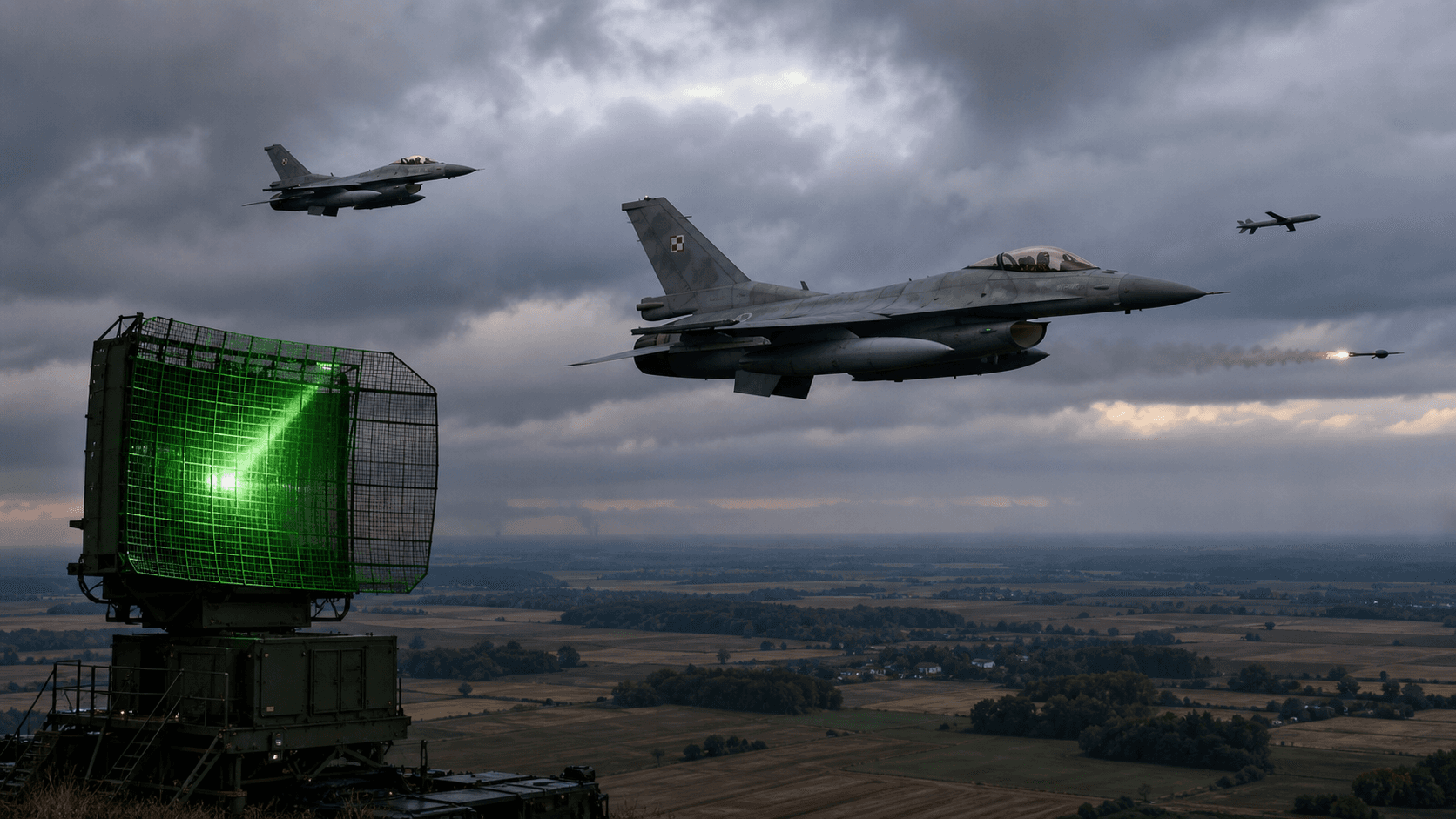
The danger on NATO's eastern edge is no longer confined to grim map rooms or alliance communiques. Each new Russian barrage against Ukraine now carries the possibility that missiles, drones or debris will cross into allied airspace and force a split second military response from countries that are not formal parties to the war. That is why the latest stretch of attacks has felt so consequential. When Russia intensifies the pressure on Ukraine, Poland and Romania do not watch as distant observers. They scramble aircraft, issue public alerts and prepare for the possibility that a violation meant as intimidation, carelessness or escalation could demand a direct answer.
Recent reporting and official statements show how steadily that risk has grown. ABC reported this week that Poland said its airspace was repeatedly violated by drone type objects during a major Russian strike on Ukraine, a reminder that even a single night of heavy attacks can spill beyond the front. The Associated Press separately described a wider Russian onslaught that tested Ukraine's air defenses and kept western regions under pressure, the same battlefield context that makes more spillover near allied territory easier to imagine. NATO had already convened allies earlier this month to condemn violations in Poland and Romania and to declare that Russia bears full responsibility for behavior the alliance called dangerous and unacceptable. The picture is not of one freak event. It is of a border zone settling into a new and more combustible normal.
Prediction markets have responded by treating another direct intercept as a live possibility rather than an abstract tail risk. On Polymarket's visible Breaking list on August thirtieth, the market asking whether NATO would down another Russian drone by mid September sat near the top movers after jumping sharply, reflecting a view that the pattern of incursions and allied readiness has become too frequent to dismiss. Traders are not calling a clash inevitable, but they are no longer pricing it like a remote hypothetical either.
That matters because every successful intercept solves only the immediate problem. It does not answer the larger strategic question of how the alliance keeps deterring spillover without allowing repeated violations to become routine. Russia has every incentive to test thresholds, whether deliberately or by accepting higher operational risk around NATO borders while pounding Ukraine harder. The alliance, for its part, wants to demonstrate that allied territory is not porous and that hesitation will not be mistaken for weakness. Between those two instincts lies the narrow space in which the next incident will be judged. If the coming days bring another large attack on western Ukraine, NATO may again face the same uncomfortable choice: contain the danger quietly, or act visibly enough that Moscow understands the frontier is no longer a free buffer for wartime miscalculation.