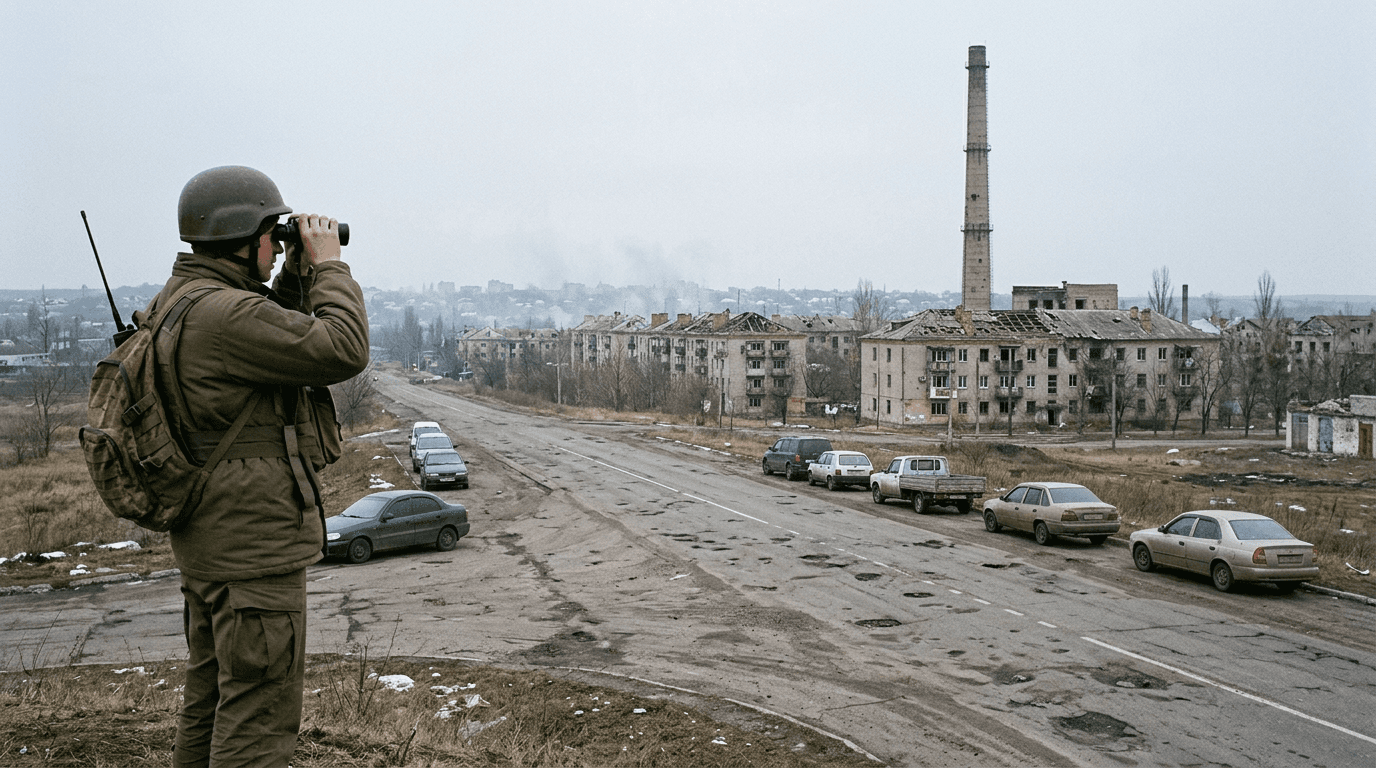
The question of whether Russian forces can reach more of Ukraine’s Donetsk region turns in part on Kostiantynivka, where control remains contested. The Kyiv Independent describes the four-city fortress belt as the backbone of Ukraine’s defense in Donetsk Oblast. Russian forces are still trying to push from Kostiantynivka toward Druzhkivka, while Ukrainian troops remain entrenched in the city center and on its eastern outskirts. That makes the battlefield there consequential well beyond the city itself.
The uncertainty is not just about movement on a map, but about what counts as control. Ukraine rejected Russian claims that Moscow controlled Kostiantynivka and said its forces were still operating against Russian infantry infiltrators there. The dispute underscores why claims of presence and control are not interchangeable. It also leaves open whether Russian forces can sustain movement from Kostiantynivka toward the next cities in the fortress belt.
Markets reflect that uncertainty, but the trading behind some prices is slight. On Polymarket, traders put Russia’s entry into Druzkhivka by the end of next year at 74%, as of 10:13 a.m. ET on Nov. 16; the market has no trading on record. For Kramatorsk by the same deadline, traders put it at 38%, with just $50 in trading over the last day. That price was down 14 points over the week. For Sloviansk by the end of next year, the market stood at 33%, with $97 in trading over the last day; it was down 20 points over the week. These figures are snapshots of what traders believe, not settled judgments about what the battlefield will bring.
The nearer deadlines show lower prices on the same cities. Polymarket traders put entry into Druzkhivka by June of next year at 56%, alongside $428 in trading over the last day. Kramatorsk by then was at 18%, with no trading on record, while Sloviansk was at 26%. The gap between the nearer and later deadlines reflects the different time available for events to unfold; it does not resolve whether Russian forces can make or hold the advances in question. The markets also should not be read as a single probability distribution across cities: the listed contracts do not partition into mutually exclusive outcomes.
There is reason not to mistake pressure for an imminent collapse. A Kyiv Independent analysis said Russian territorial gains had largely flatlined this year even as fighting remained intense, and described Ukrainian defenses holding in Kostiantynivka. The same analysis said Russian advances and longer-range drones had made logistics across the fortress belt more difficult and driven many remaining civilians from their homes. How much ground Russia can take, and whether any movement amounts to control rather than infiltration or a claim, remains unsettled. For civilians and Ukraine’s defense, the consequences are already serious; the market prices do not settle what happens next.