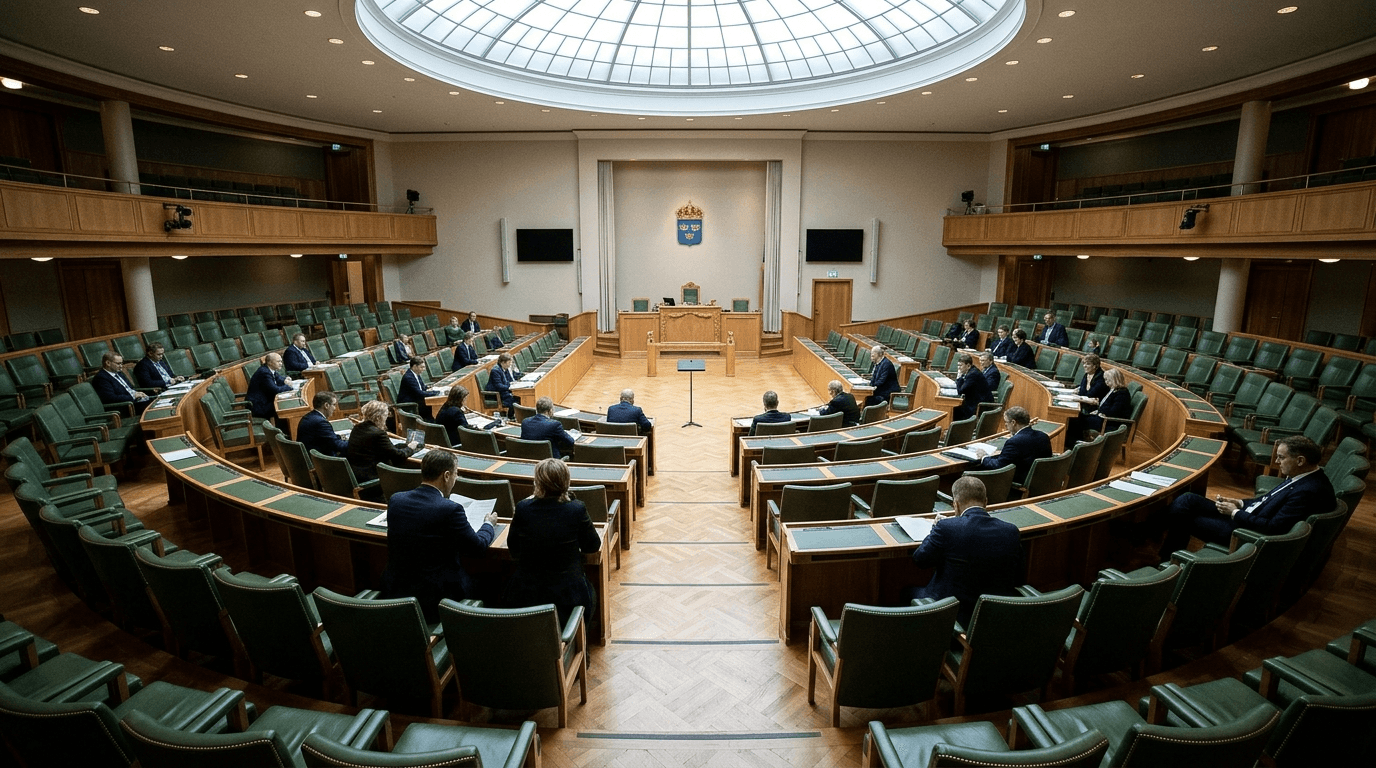
Sweden’s election has left the country without an agreed path to its next government. The centre-right bloc won 173 seats, while the centre-left bloc has not agreed on how to share power. That leaves the central question unresolved: can caretaker Prime Minister Ulf Kristersson assemble enough parliamentary support, or can Magdalena Andersson do so instead? The result is not simply a contest between two names. Each leader needs a workable arrangement among parties, and the available reporting describes that task as deadlocked.
The process has already tested another possibility. On Tuesday 3 November, parliament rejected the Speaker’s proposal of Centre Party leader Elisabeth Thand Ringqvist as prime minister. The Speaker then asked Kristersson to explore forming a government. Kalshi’s contract on Kristersson stood at 52% as of 7:56 a.m. ET on Nov. 7. That figure represents what traders currently believe, not a forecast of who will lead Sweden. It signals that Kristersson is the more likely of the named leaders in this market snapshot, while leaving a substantial possibility that he will not become prime minister. A market price cannot establish whether parliamentary support is available.
Andersson remains a serious alternative, but her route is complicated by divisions among the centre-left parties. The Centre Party has ruled out joining a government with the Left Party, and the bloc has not agreed how to share power. At the same time, the Centre Party is hearing from both leaders. It gave them a week to present their agendas and explain how they would pass them through parliament. Kalshi’s contract on Andersson stood at 39% at the same time. The prices put her behind Kristersson, but they do not show whether either leader can win support. The difference is a measure of traders’ current beliefs about the outcome, not proof that one leader has a viable parliamentary route and the other does not.
The seat count alone does not resolve the standoff. The opposition has a narrow advantage, but its parties have not agreed on a workable arrangement. Kristersson’s bloc has fewer seats, yet the Centre Party has not ruled out considering his proposals. Its decision could matter to either leader’s attempt to govern, but the available evidence does not show what terms would bring it on board. The Centre Party says it will hear both agendas and how each could be passed through parliament. Until it has weighed those proposals, the balance of seats does not by itself reveal who can assemble the support needed to govern. The negotiations, rather than the market ranking alone, are central to the uncertainty.
There is also a procedural limit: the Speaker can put forward four candidates before a new election has to be called. That possibility marks the stakes of continued deadlock, not a prediction that Sweden is headed for another vote. The available reporting does not establish whether the Speaker will need to put forward another candidate, whether either leader can secure support, or when a government will form. For now, the evidence points to competing paths and unresolved parliamentary arithmetic. Traders place Kristersson ahead of Andersson on Kalshi, but the market cannot show whether either can assemble support. Sweden’s next government depends on negotiations still under way, and the outcome remains uncertain.