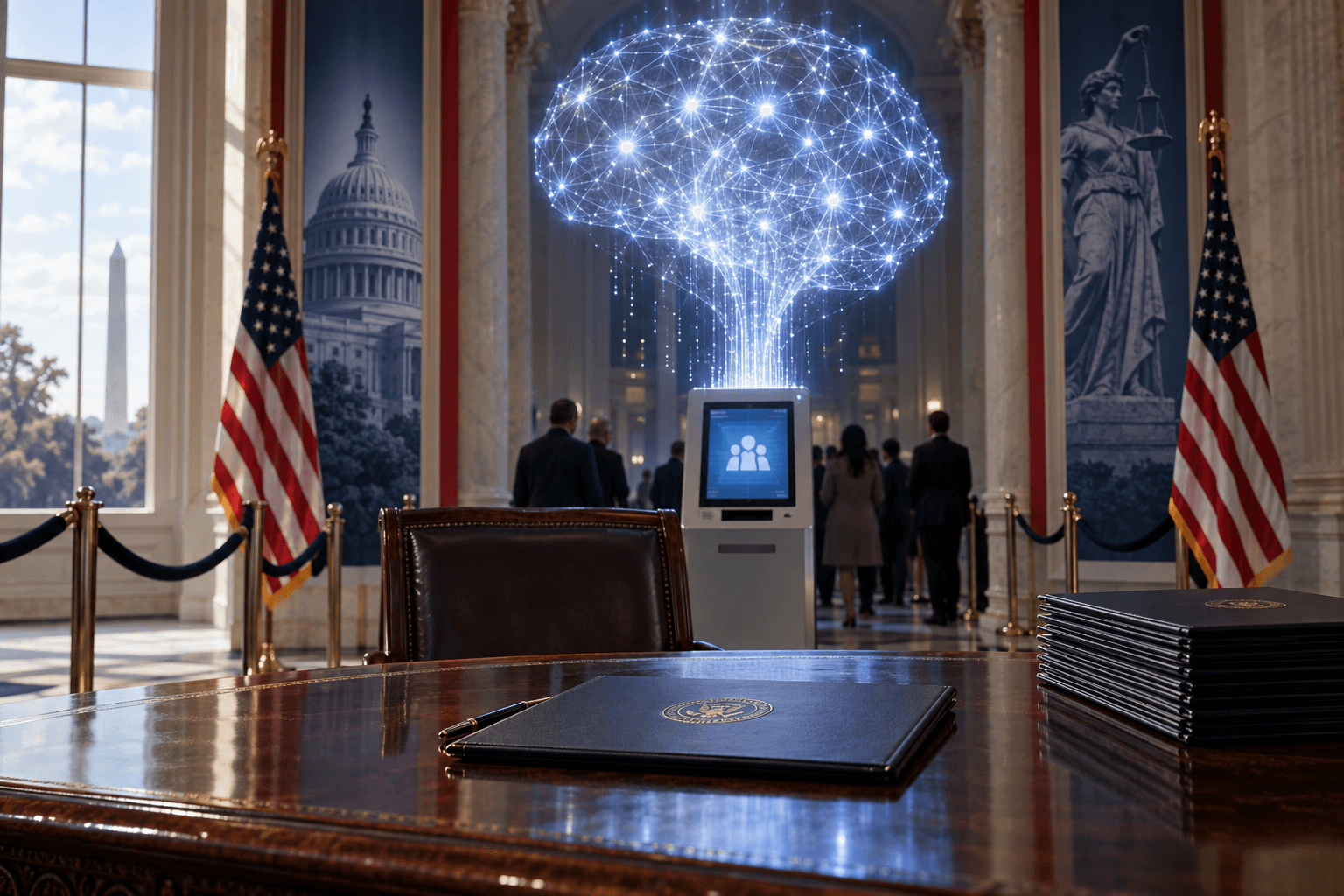
President Donald Trump used Tuesday’s unveiling of America.gov to press a broader vision of artificial intelligence as a national project that should expand quickly and face limited federal restraint. The new site is designed to answer questions about government services using official sources, while the president told an audience of technology executives that he would not stifle a technology he compared in significance to the industrial revolution. The launch gave the administration a public-facing product for its AI agenda, but it also revived scrutiny of an unusual linguistic campaign: Trump’s effort to make “super intelligence” the government’s preferred term for the technology.
That terminology did not appear from nowhere. In a White House account of last week’s state visit by Chinese President Xi Jinping, the administration said the two leaders agreed to use “super intelligence” rather than “artificial intelligence” for applicable emerging technologies and established a bilateral dialogue under the new label. Trump had also used the phrase at the United Nations. Those statements indicate clear political intent, but a qualifying federal action would still need to take the form of a signed executive order, proclamation or presidential memorandum directing the government or an agency to adopt a replacement name for the technology itself. Speeches and incidental wording would not carry the same force.
Tuesday’s America.gov debut underscored the policy stakes behind what could otherwise look like branding. Reporting found that the government-sourced chatbot sometimes produced answers that contradicted Trump’s own claims, illustrating how an official AI service can create tension between political messaging and the source material agencies publish. At a separate White House gathering, technology leaders urged caution about powerful systems even as Trump argued that regulation could surrender an American advantage. A formal terminology directive would therefore land amid a larger debate over whether the administration’s priority is institutional control, public-service deployment or rapid private-sector development.
Prediction traders reacted as if a binding action was imminent. The Polymarket contract on a qualifying change by September 30 traded near 97.5% in the latest snapshot, about 73 percentage points higher over 24 hours. Activity across the related outcomes exceeded $617,000 during that period. Those prices measure traders’ view of whether the specific paperwork threshold will be met; they do not prove that a document has been signed or that every agency has changed its language. The distinction matters because earlier White House remarks and the U.S.-China fact sheet alone do not satisfy the stated rules.
The decisive evidence should be public and easy to identify: a presidential action posted by the White House or entered in the Federal Register. Until that text appears, the administration has a declared preference, a new government chatbot and a widening policy campaign, but not necessarily a binding instrument. If Trump signs such a directive, agencies will then have to decide how far the new label reaches across procurement, research, regulation and public communications. If he does not, the sharp repricing will become a reminder that even strong expectations can outrun the formal machinery of government.