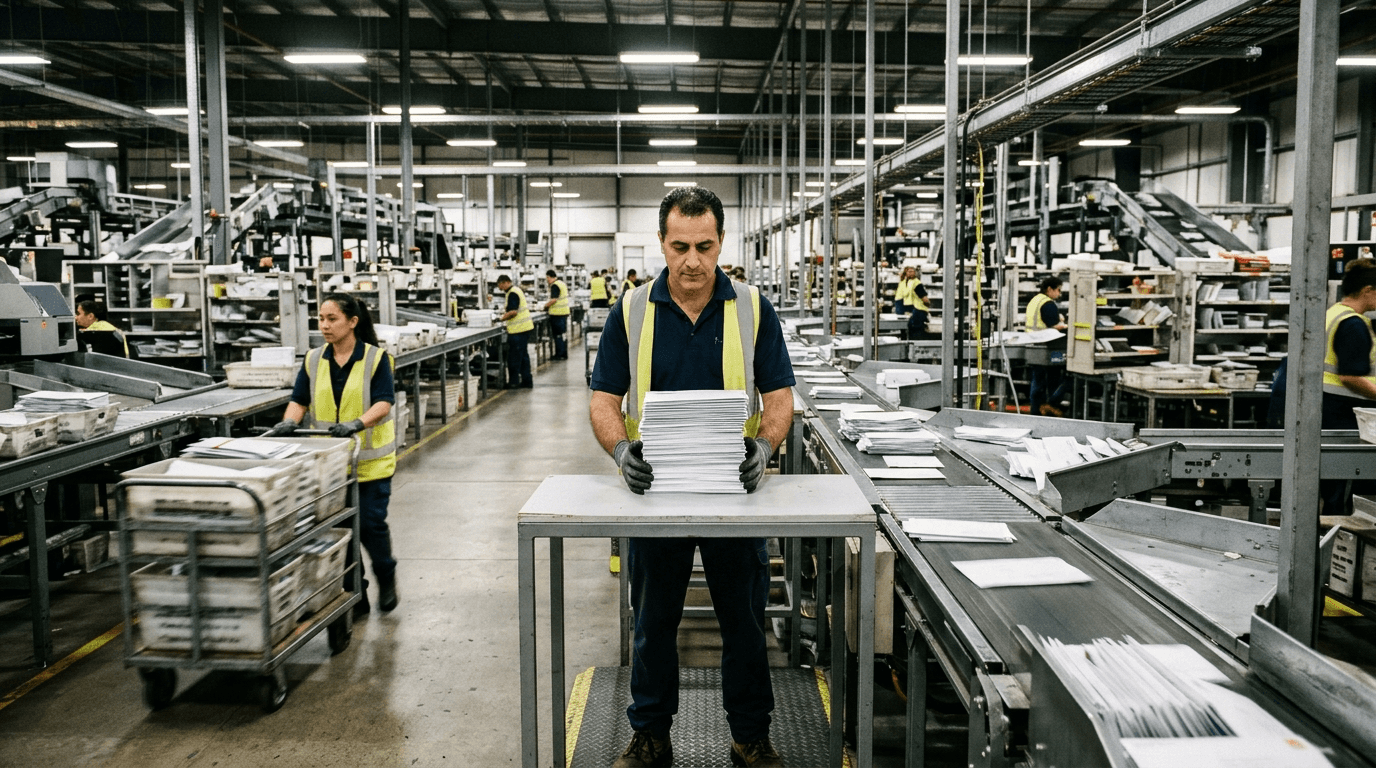
The question is whether the government’s election order led the U.S. Postal Service to block large numbers of mail ballots—not simply whether parts of the order survived legal challenges. The order sought to have USPS withhold ballots from people absent from government lists of verified voters, according to TIME. That possibility touches a basic question for voters: whether their ballots can reach the process that counts federal election results. But the available reporting does not establish that USPS actually blocked ballots under the order, or how many might have been affected.
The legal picture described in the reporting is mixed, but the specific USPS provision remained constrained. A federal judge blocked implementation or enforcement of the order before the general election, according to Washington’s secretary of state; the office gives the date as June 25. The Supreme Court later allowed some parts of the order to proceed, but ABC News reported that the ballot-withholding provision remained blocked in a separate case. Washington’s secretary of state also said USPS could not impose new restrictions on ballot mail before the election, a statement dated Sep. 14, 2026. Those developments distinguish the order’s surviving provisions from the measure at the center of this question.
On Kalshi, traders put the chance of USPS blocking at least roughly 20,000 distinct ballots under the order or a materially equivalent measure at 2% as of 12:16 p.m. ET on Nov. 5. That is a reading of traders’ current belief, not an objective probability or a forecast. The price was up 1 point in the last day, with 372 contracts traded over the last day and 1,664 contracts open. The market’s narrow threshold matters: it asks about a reported action by specified source agencies before a specified cutoff, not every ballot that may be rejected, delayed or affected for another reason. The contract’s trading deadline is Nov. 10; that is when trading closes, not a finding about when ballots were handled.
There is a reason not to treat the court decisions as a complete accounting of what happened at postal facilities. The cited reports do not say whether USPS blocked any ballots pursuant to the order, and they provide no official tally of such ballots. Washington’s account concerns that state’s elections, not a nationwide count. Separately, TIME reported that the Supreme Court rejected an administration request for California to set aside ballots from people identified as possible noncitizens; the report put the number of voters involved at roughly 20,000. That is a distinct dispute and should not be confused with evidence that USPS withheld ballots under this order.
For now, the clearest reported evidence points to the ballot-withholding provision being blocked, even as other parts of the order were allowed to proceed. That does not answer whether any ballots were blocked in practice, nor does it settle whether the contract’s threshold was reached. The market’s low reading captures traders’ current assessment of the specified outcome; it cannot substitute for USPS or election-agency records. The unresolved question is therefore both legal and factual: what happened to ballots, under what authority, and whether an official count exists that can distinguish this order’s effects from ordinary ballot rejection or delivery problems.