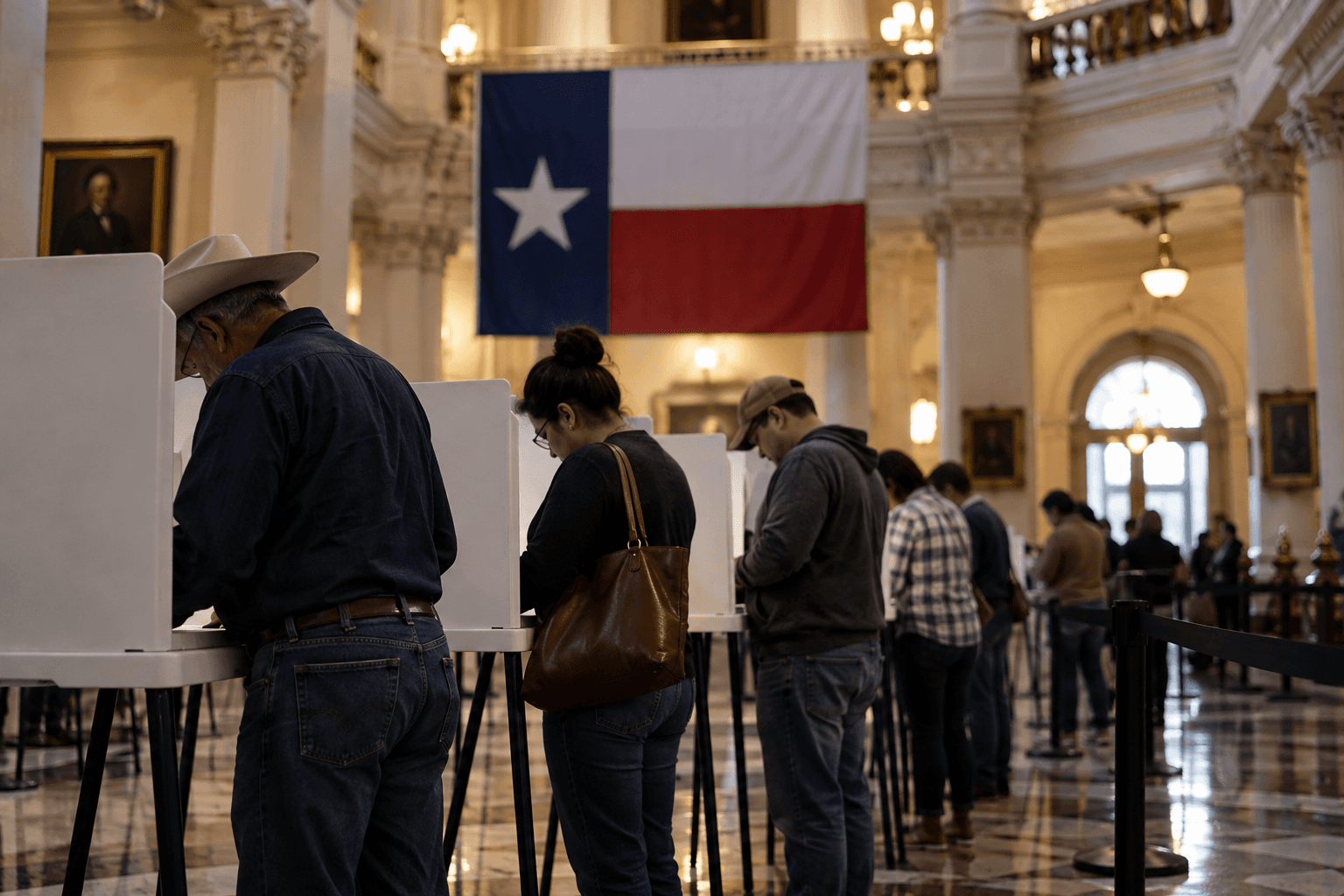
Two new public polls keep Democrat James Talarico narrowly ahead of Republican Ken Paxton in the Texas Senate race, reinforcing the view that a seat long held by Republicans is genuinely competitive. Emerson College's September survey put Talarico at 47 percent and Paxton at 46 percent among likely voters, with 4 percent undecided and Libertarian Ted Brown at 2 percent. A separate ReconMR poll showed a wider 49-to-43 lead for Talarico. The surveys point in the same direction but not by the same margin, a reminder that the race remains sensitive to turnout assumptions and sampling choices.
Emerson's movement from August was small: Talarico gained one point while Paxton lost one. Its survey also found Talarico leading Hispanic voters 54 percent to 39 percent, even though that group supported Donald Trump in 2024. ReconMR reported particularly large Talarico advantages among independents, younger voters and voters in major metropolitan regions, while Paxton remained strongest among Republicans, rural voters and people age 65 or older. Subgroup results carry larger uncertainty than statewide figures, but the pattern shows the competing coalitions each campaign is trying to assemble before November.
The polls do not establish a durable lead on their own. Emerson surveyed 1,000 likely voters from September 12 through 14 with a three-point credibility interval. ReconMR surveyed 614 likely voters from September 8 through 11 with a 4.3-point margin of error. The Texas Politics Project's nonpartisan tracker lists both alongside other recent polls that range from a Paxton edge to a Talarico advantage. The common signal is competitiveness, not certainty. Economic concerns also dominate the campaign: Emerson found 36 percent naming the economy as the state's top issue, well ahead of immigration, education and health care.
Polymarket's Texas Senate contract placed the Democratic outcome near 61 percent Monday morning, about ten percentage points higher than a week earlier, with the Republican outcome around 41 percent. That is a meaningful shift in traders' expectations since the previous MPN coverage, but it is not a vote forecast or a substitute for polling. The contract also reflects campaign spending, candidate news and traders' risk preferences, while the election itself will be decided by turnout and certified ballots on November 3.
The next test will be whether additional independent polls reproduce Talarico's advantage after both parties intensify advertising and voter contact. Paxton needs to consolidate Republicans who remain uneasy about his legal and political record, while Talarico must protect gains among independents and Hispanic voters without losing ground with older voters who participate at high rates. Early voting begins before Election Day, so the window for changing perceptions is narrowing. Texas has not yet become a Democratic state, but the latest evidence gives both parties a practical reason to treat this Senate contest as a top-tier battleground.