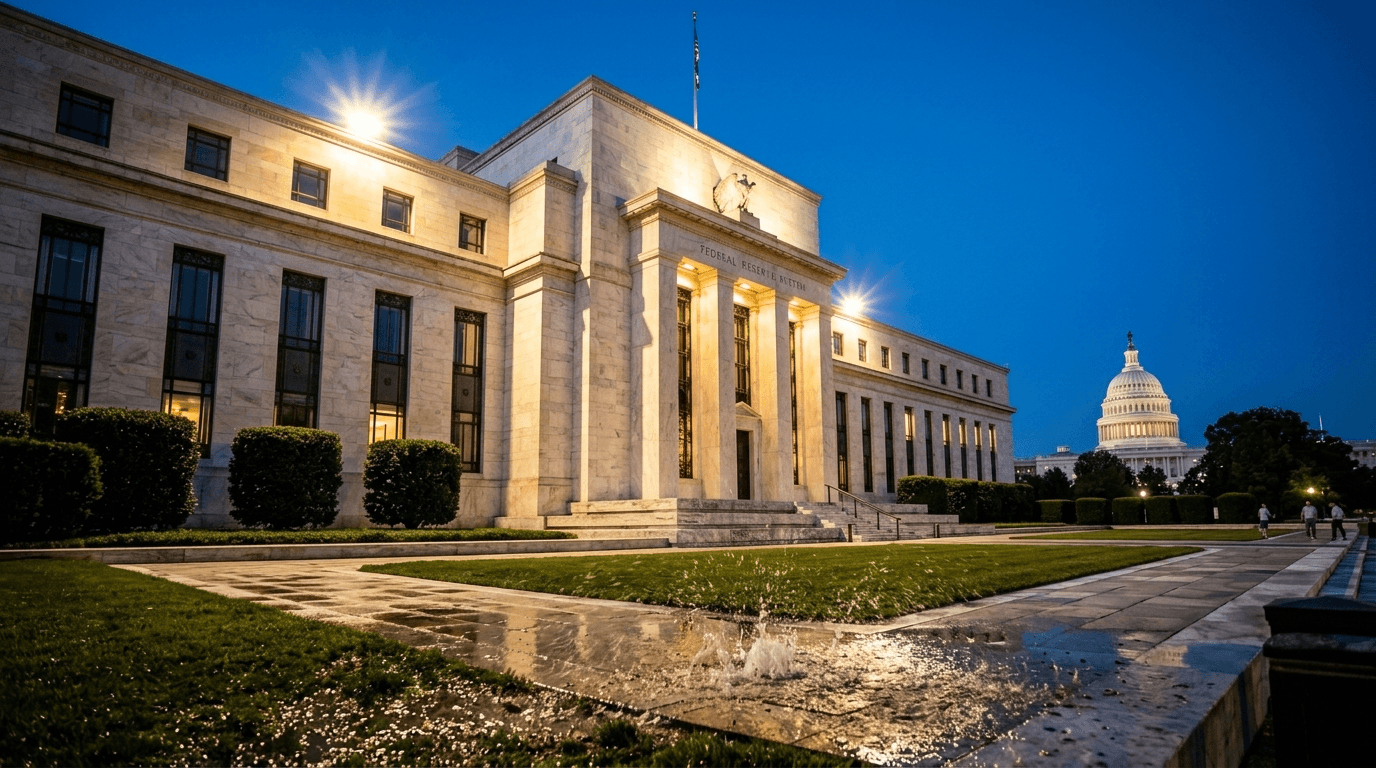
Prediction markets now assign a 37 percent probability that the Federal Reserve will raise its benchmark policy rate by 25 basis points at its December 2027 meeting, according to Kalshi data, reflecting a sharp 68-point surge in implied odds over the past day. The contract, which drew $15,759 in trading volume during that period, closes on December 8, 2027, just before the Federal Open Market Committee announces its decision.
The jump in hike expectations comes as major banks publish sharply divergent forecasts for late-2027 monetary policy. Goldman Sachs Research projects the Fed will deliver its final two rate cuts of the current cycle in June and December 2027, pushing back earlier expectations and indicating an easing bias into year-end. By contrast, J.P. Morgan Global Research expects the central bank to remain on hold through 2026 before delivering a 25-basis-point hike in September 2027, with risks skewed toward an earlier tightening move. CME FedWatch data from mid-2026 showed elevated odds of rate increases by late 2026 and early 2027, with some derivatives pricing indicating a roughly 51 percent chance of a hike by March 2027.
Under Chair Kevin Warsh, the Fed held its target range steady at 3.5 to 3.75 percent earlier this year, and projections released at that meeting indicated an expected 25-basis-point increase by end-2026. Minutes from the June FOMC meeting revealed a unanimous decision to hold rates, with no expectation of cuts until early 2027, though a small number of officials favored a hike at that session. Market commentary tracking derivatives pricing reports that rate hikes are now seen as more likely than cuts, with some estimates showing no cuts expected until December 2027, underscoring a hawkish shift in sentiment.
The divergence between Goldman's easing scenario and J.P. Morgan's tightening call highlights the high path uncertainty facing traders. Fed projections and minutes only extend through early 2027, and geopolitical shocks—including renewed Middle East tensions cited in recent coverage—have already shifted probabilities substantially. Current pricing for December 2027 remains sensitive to evolving inflation data and external events rather than anchored to any single baseline forecast.