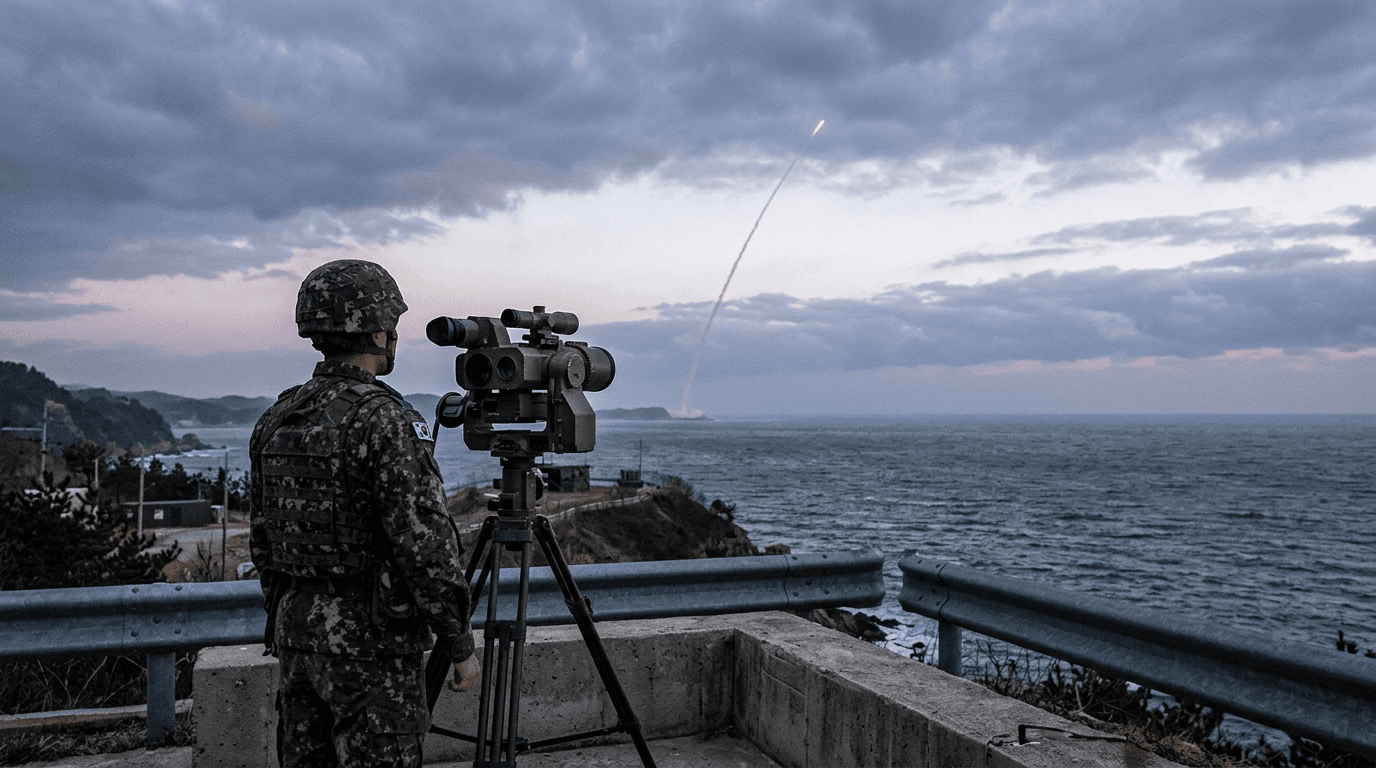
Missile activity near the start of November puts regional security in focus, but it does not reveal how many tests North Korea will conduct during the month. South Korea’s military said the North fired about a dozen short-range ballistic missiles toward the East Sea in late October. Two days later, North Korea’s Missile Administration conducted a cluster-warhead test, according to the account carried by KCNA. These reports document activity; they do not provide a schedule or a reliable forecast for November.
The market’s prices reflect competing possibilities rather than a settled view. On Polymarket, traders currently assign 32% to exactly one test, 27% to exactly two, and 22% to exactly three, as of 7:57 a.m. ET on Nov. 1. The price for three tests was down 1 point over the week; the other listed outcomes showed no change over the week. The contracts divide the month into fewer than one test, exactly one, exactly two, exactly three, and four or more. That distribution is a snapshot of traders’ beliefs, not an objective probability or a forecast of what North Korea will do.
There is little trading behind much of that snapshot. The contract for exactly one test had $28 in trading over the last day, while the contract for exactly two had $1K in trading over the last day. The other outcomes recorded only $60 in trading over the last day for three tests, $75 in trading over the last day for fewer than one and $30 in trading over the last day for four or more. Those uneven, small amounts of trading counsel against treating fine differences among the prices as strong evidence. The board’s prices also show no cross-venue confirmation, so the market offers no independent second venue to compare.
The reported events themselves carry important qualifications. South Korea’s Joint Chiefs of Staff said the late-October missiles flew about 250 kilometers, and that further analysis of their specifications was underway with the United States. South Korean military reporting described a mixed-salvo drill as a possibility, not a confirmed account. For the later test, Yonhap reported that South Korea’s military tracked activity before the launch and maintained readiness in coordination with the United States. North Korean state media said the country planned to enable military units to use four categories of cluster warheads by year-end; that statement is a claim from state media, not independent confirmation of the test’s reported capabilities.
The late-October launches and warhead test could suggest heightened activity, but the available reporting does not show that the pace will continue. It establishes neither whether there will be another test in November nor how many there might be. The trading deadline shown for the contracts is Nov. 30, but that is when trading closes, not a prediction about when any event will occur. For now, the clearest conclusion is also the narrowest: recent activity warrants attention, while November’s total remains unknown.