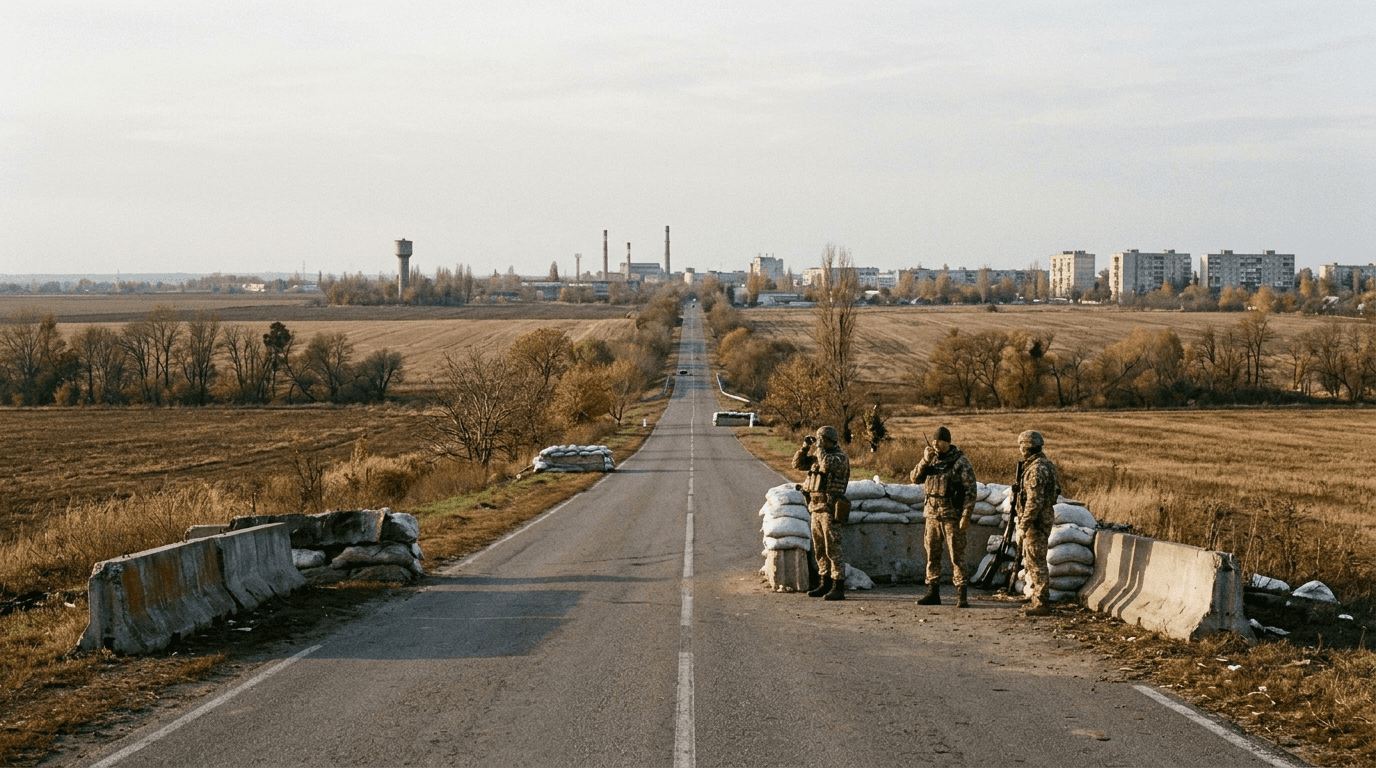
The fight over eastern Ukraine’s cities is also a fight over the defense of Donetsk Oblast. The Kyiv Independent describes the four-city fortress belt as the backbone of that defense, with Russia seeking to capture the rest of the region. Yet reporting does not establish that the cities in these contracts have fallen, and “enter” is not necessarily the same as securing control. On Polymarket, traders put the chance of Russian entry into Druzhkivka by the end of this year at 29% as of 1:51 p.m. ET on Oct. 29. The contract recorded $6K in trading over the last day; that price is a snapshot of traders’ beliefs, not a forecast.
For Druzhkivka, the longer deadlines produce a markedly different picture. Traders put entry by the end of next year at 83%, while the June deadline is at 73%. The shorter-deadline price down 7 points in the last day, but only $87 in trading over the last day. The contract for entry by the end of next year has no trading on record, so its quoted price should be treated cautiously. Separately, Ukrinform reported that About 4,000 people remained in Druzhkivka. That gives the question a human stake beyond the market: the town is not just a point on a battlefield map.
The prices for Sloviansk and Kramatorsk are closer to an even split, but the books offer little support for confident conclusions. Traders put entry into Sloviansk by the end of next year at 53% and by the June deadline at 43%; neither contract has trading on record. For Kramatorsk, the end-of-next-year contract is at 51%, with $1K in trading over the last day. Its June contract is at 47%, after up 6 points in the last day on just $150 in trading over the last day. These are separate deadlines, not a single shared forecast, and limited activity means the prices may not represent a deep consensus.
The stakes extend beyond the immediate fate of any one city. BBC reported that Sloviansk and Kramatorsk were the largest cities still under full Ukrainian control in eastern Donbas and that civilians were being urged to leave. The report also said Russian ground assaults had focused on territory near the cities, whose capture could ease further advances west. Those reports describe pressure and risk; they do not establish that Russian forces have entered the cities. For readers, the uncertainty concerns both the defense of the region and the safety of people living near the front.
There is a reason not to read every price as momentum toward a Russian advance. The Kyiv Independent reported that efforts to push through terrain east of the fortress belt had bogged down over autumn, while Kostiantynivka continued to hold. It also described Russian and Ukrainian troops overlapping in residential and industrial areas there, making claims about control difficult to establish. That distinction matters: presence in a place, a flag-raising video, and control of a city are not necessarily the same thing. The markets frame an unresolved question, but the reporting points to a contested battlefield—not an inevitable outcome.