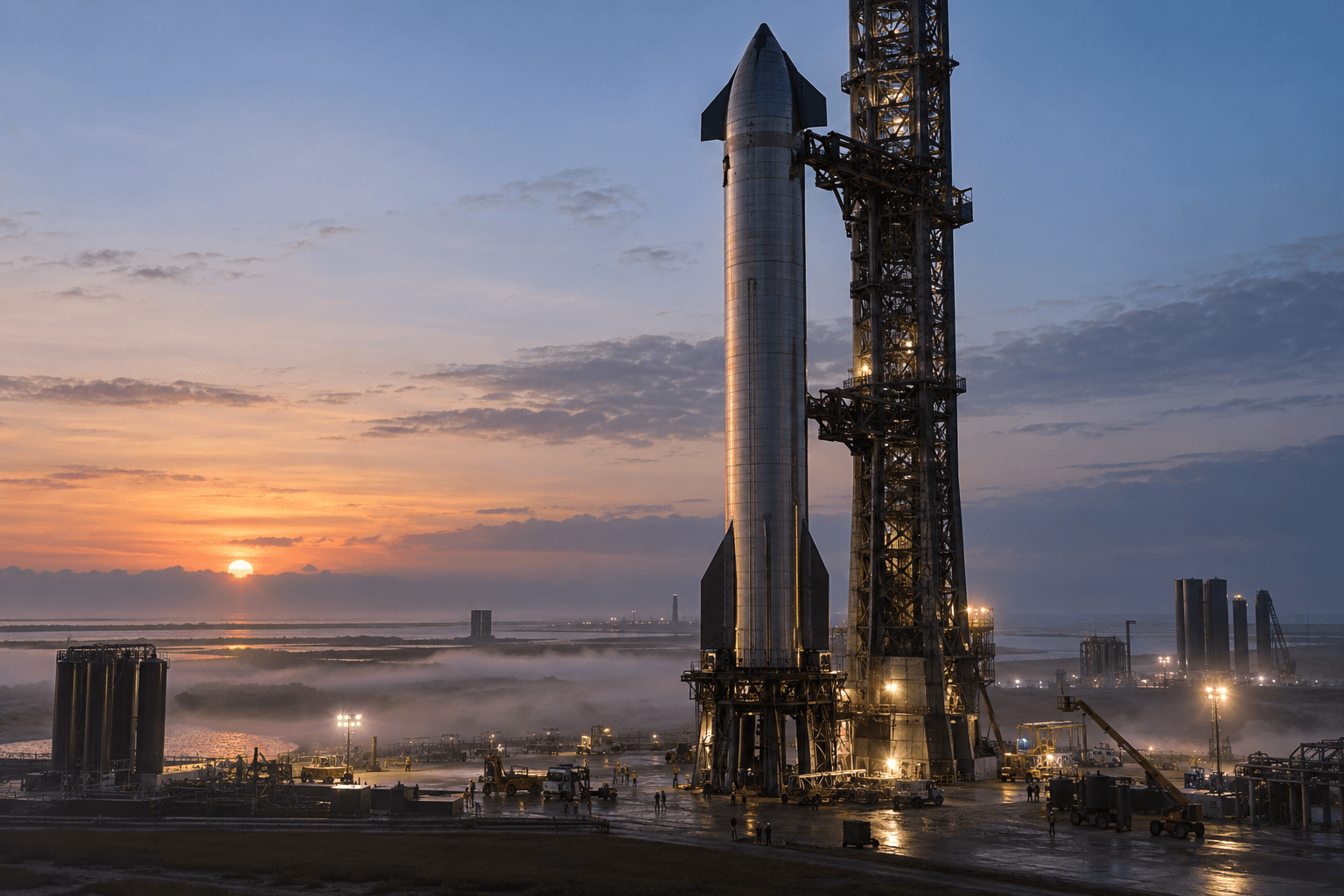
SpaceX is approaching the launch window for Starship Flight 14, a mission expected to attempt the giant rocket's first full orbital flight after thirteen integrated tests. Public launch trackers place the mission in mid-September, but SpaceX had not posted the final launch confirmation reflected in those trackers as of Saturday. The flight is expected to use the Ship 41 upper stage and Booster 21 from Starbase, Texas. If the schedule holds, the mission would move Starship beyond the suborbital profiles used so far and test whether the latest vehicle configuration can complete a more demanding trip around Earth. Success would be an important bridge between experimental flights and the operational roles SpaceX envisions for satellite deployment and lunar missions.
The hardware and mission profile make Flight 14 more than another repetition. Spaceflight Now says the launch may carry a group of Starlink Version 3 satellites, which would give the vehicle a practical deployment test in addition to its development objectives. Next Spaceflight identifies Ship 41 and Booster 21 as the assigned vehicles and lists the mission as the first orbital Starship flight. Its readiness checklist, however, still showed several major items incomplete, including confirmation from SpaceX, vehicle stacking and launch-area notices. That gap explains why schedule estimates should be treated as targets rather than commitments. Rocket testing, range coordination and licensing steps can move a launch with little notice, especially when a new trajectory or vehicle configuration is involved.
Prediction markets have repriced the timetable as preparations advanced. The Polymarket outcome for a launch by September 30 stood near 92% on Saturday, up about 10 percentage points over the preceding day. A narrower September 19 outcome rose 31 points to 46%, while the September 26 contract climbed 25 points to 75%. Across the Flight 14 family, total activity was about $508,000, with roughly $6,600 traded in the latest 24 hours. These are trader-implied probabilities, not an official launch schedule. The steep difference between the September 15 and September 19 contracts underscores how sensitive expectations remain to a few days of operational progress.
Regulatory groundwork has also advanced, though it should not be mistaken for mission clearance. The Federal Aviation Administration published a completed environmental review covering additional trajectories and Starship return-to-launch-site profiles at Boca Chica, building on earlier work that allowed a higher annual cadence. Flight-specific operations still depend on the appropriate license, airspace coordination and safety notices. The next decisive signals will be SpaceX's mission announcement, Ship 41 and Booster 21 appearing as a stacked flight vehicle, and the FAA, Coast Guard and range notices that define the launch corridor. Weather and final propulsion checks could still intervene even after those documents appear. Until those items line up, Flight 14 is close enough to reshape expectations but not yet firm enough to put on a clock.