Spain holds a snap general election on Sunday, and the race has tightened in its final weeks. Prime Minister Pedro Sánchez called the vote on Oct. 5, after weeks of protests over housing costs, saying he needed to renew people's support. Polls have long pointed to a government led by the conservative People's Party with backing from the far-right Vox party. If that happens, it would be the first time since the death of the dictator Francisco Franco that a far-right party has entered Spain's central government.
Sánchez, in power for eight years, has changed his style. At a recent rally he thanked his wife, Begoña Gómez, from the stage. "So let them hear it loud and clear, I love you," he said, in DW's translation. He has also leaned into attacks from his opponents, telling supporters that insults are their medals and that if critics call them lefties, they are honored to be lefties. Alberto Núñez Feijóo, the People's Party leader, has framed the vote as a choice between corruption and decency. Sánchez's government faces corruption allegations involving his wife, his brother and close allies, a migration crisis in the North African enclave of Ceuta, and deadly train crashes, along with the housing crisis. Rents have risen almost 45 percent over eight years, according to estimates cited by Carla Hobbs of the European Council on Foreign Relations.
Vox has made immigration central to its campaign, and it has gained among young voters, though not evenly. "Vox's appeal is much stronger amongst young men than young women," Hobbs told DW. Polls published on Nov. 16 showed the People's Party and Vox winning a combined majority of the 350-seat Congress of Deputies, while the Socialists gained ground. The state-run CIS poll was an outlier, putting the Socialists close enough to hold power with a broad left-wing coalition. Spanish law bars publishing new polls in the five days before the vote. "We've seen Sanchez recover quite considerable ground now in the final weeks of the campaign," Hobbs said, adding that even a first-place finish might not give the Socialists enough partners to govern, while the People's Party with Vox looked well positioned for a majority.
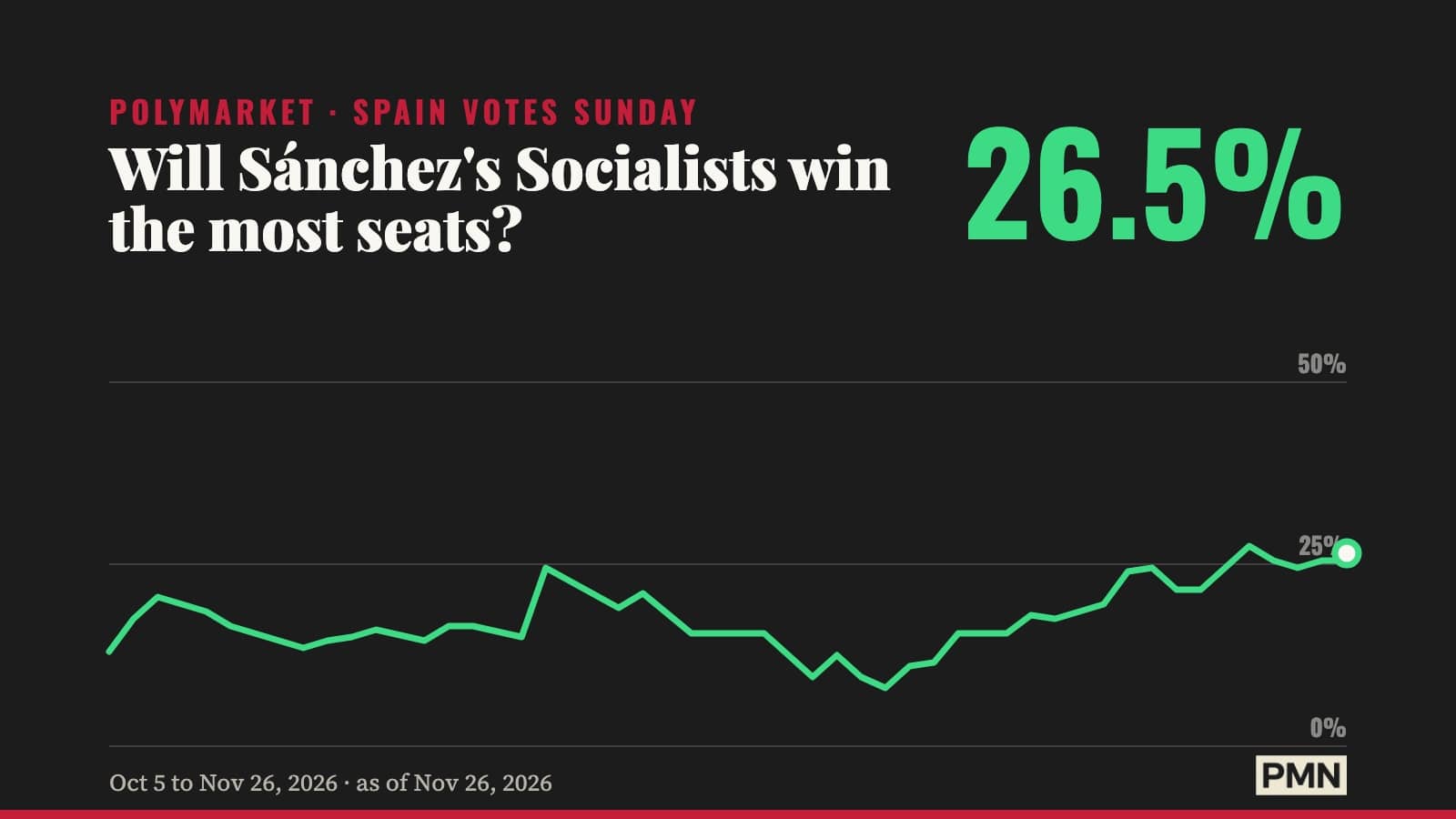
Prediction markets show the same split. On Polymarket, the chance that the Socialists win the most seats stood at 8 percent on Nov. 6 and has roughly tripled since, to 26.5 percent on Thursday. The People's Party is at 74.5 percent, and Vox below 1 percent. A separate market on the next prime minister, with more than $3 million traded, puts Feijóo at about 90 percent and Sánchez at about 10 percent. The gap between the two markets reflects the arithmetic Hobbs described: winning the most seats and forming a government are different things in Spain's parliament.
Polls close on Sunday evening, and results usually come within hours. If no bloc reaches 176 seats, the negotiations could take weeks, with Vox's demands likely to shape any government on the right. For Sánchez, a strong second place could still matter. A political analyst told DW that he may be aiming for a result that keeps him a powerful leader of the opposition, even if he cannot keep his job.