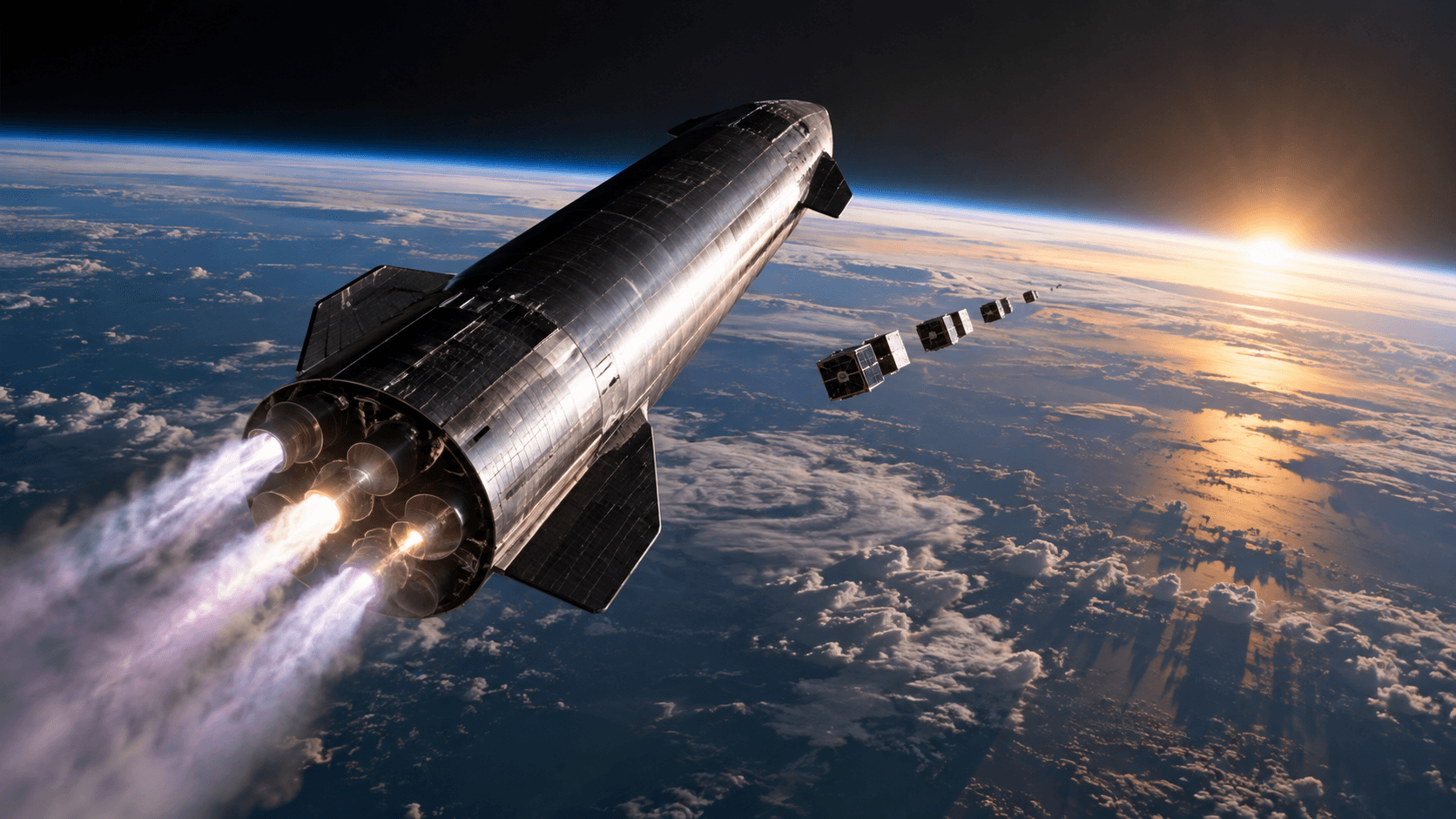
SpaceX’s Starship reached orbit for the first time on Monday and deployed 26 next-generation Starlink satellites, turning its fourteenth integrated flight into the program’s clearest step from testing toward operational service. The rocket lifted off from Starbase, Texas, at 7:48 a.m. local time and completed an orbital-insertion burn about 25 minutes later. All 26 Starlink V3 spacecraft were released, and SpaceX said its satellite team established contact with each one.
The milestone came with a serious complication. One of the upper stage’s six engines shut down during ascent, briefly leading the launch team to say it would abandon the orbital attempt. Controllers later determined the vehicle could continue, and mission control confirmed that Starship had reached orbit. SpaceX then shortened a flight that had been planned to last nearly 10 hours and about six trips around Earth. The vehicle was directed toward a pre-cleared Pacific return area after roughly three hours instead of the planned splashdown west of Chile.
The payload gives the flight importance beyond the vehicle test itself. SpaceX says each V3 satellite can add about one terabit per second of capacity, making the batch a major expansion of what one launch can deliver to the Starlink network. Three satellites also carry cameras intended to observe Starship’s heat shield from orbit. The Super Heavy booster completed a simulated offshore landing in the Gulf of Mexico, although reporting indicated that engines on both stages experienced problems. NASA is watching closely because a version of Starship is central to the agency’s planned lunar-landing architecture.
Polymarket traders had focused on whether the Super Heavy booster would explode during the flight. That outcome finished near a 99.9% implied probability after a move of about 18 percentage points, with roughly $19,100 traded over the latest day. The contract is a narrow description of one flight event, not an overall verdict on the mission. Reaching orbit and deploying all 26 satellites were substantial achievements even as the early return and engine failures underscored how much technical work remains.
SpaceX will now have to explain the engine shutdowns, evaluate data from the shortened orbital phase and determine whether the vehicle followed its planned disposal corridor. The company had said the next test could attempt a tower catch of the upper stage if this mission met its goals, but that decision will depend on the investigation and on regulatory review. Flight fourteen demonstrated that Starship can carry a large operational payload into orbit, a capability the company needs for the next generation of Starlink. It also showed why the program is still a test campaign: the rocket achieved its central milestone only after mission controllers worked through failures that could have ended the attempt.