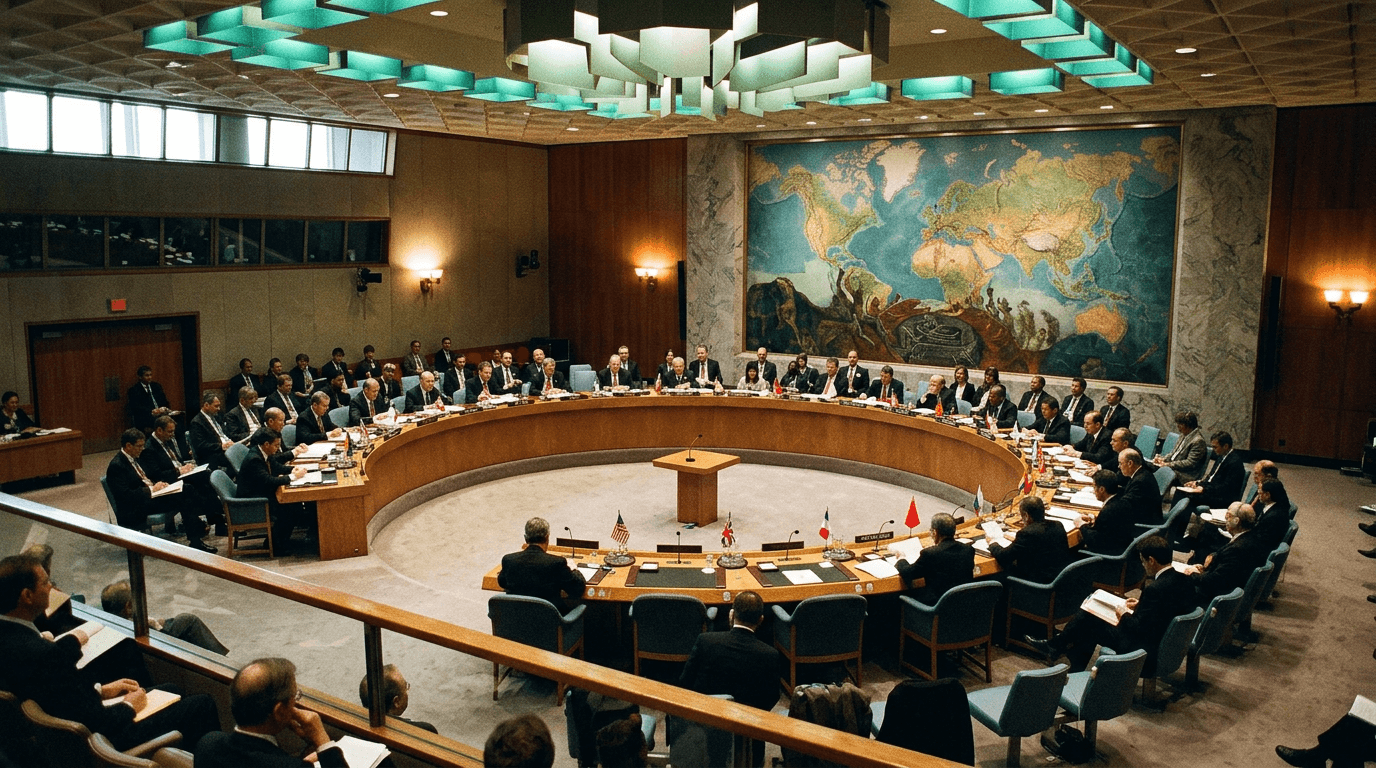
The next United Nations secretary-general will lead the organization’s Secretariat and global operations, while serving as a mediator, advocate and public voice on global crises. The choice remains unsettled: Rebeca Grynspan led the latest Security Council straw poll, but the leading candidates all faced opposition from members with veto power. That poll offers a view of the contest, not a final decision or a guarantee of how the Council will act.
Grynspan received nine encouraging votes in the latest poll, according to The National. Rafael Grossi and Carolyn Rodrigues-Birkett each received eight encouraging votes. Yet none of the seven candidates had the support of all five permanent members, each of whom has veto power. That distinction matters: leading the poll is not the same as clearing the obstacle that could prevent the Council from recommending a candidate. The ballots were secret, and public reporting does not identify which governments cast particular votes, so the reported opposition cannot be assigned to named countries here.
Kalshi’s market gives Grynspan the largest individual share of traders’ current beliefs. Her contract stood at 44% as of 7:55 a.m. ET on Oct. 18. Grossi was at 22%, and Rodrigues-Birkett at 14%. These prices describe what traders currently believe; they are not forecasts or objective probabilities. The market’s ranking therefore provides a snapshot of expectations, not evidence that Grynspan has secured the support needed to become secretary-general. Its prices and the Council poll address related but different things: one records traders’ beliefs, while the other reports candidate support in the selection process.
The trading snapshot has limits of its own. Grynspan’s contract saw 415 contracts traded over the last day, while Grossi’s saw 257 contracts traded over the last day. Several other listed candidates had no contracts traded over the last day. These are counts of contracts, not a measure of whether traders’ views represent the wider public or the Council. Nor does the market answer the central political question: whether any candidate can win support without a permanent-member veto. The poll was the first in the process to use colour-coded ballots separating votes by the five permanent members. That change distinguishes the permanent members’ votes from those of elected members, but the public reporting still does not identify who cast particular ballots.
A different candidate could still emerge if the current field cannot win over the veto-wielding members, ABC News reported. A new entrant would not necessarily resolve the impasse; that candidate, too, would need to secure Council support. The next secretary-general is expected to begin work when António Guterres’s term ends at 31 December 2026. The role’s responsibilities make the outcome consequential, but the available evidence leaves the contest open: the poll has not settled the choice, and the market cannot show how Council members will act. For now, the clearest conclusion is not that one candidate is certain to prevail, but that the leading names still face a common institutional hurdle.