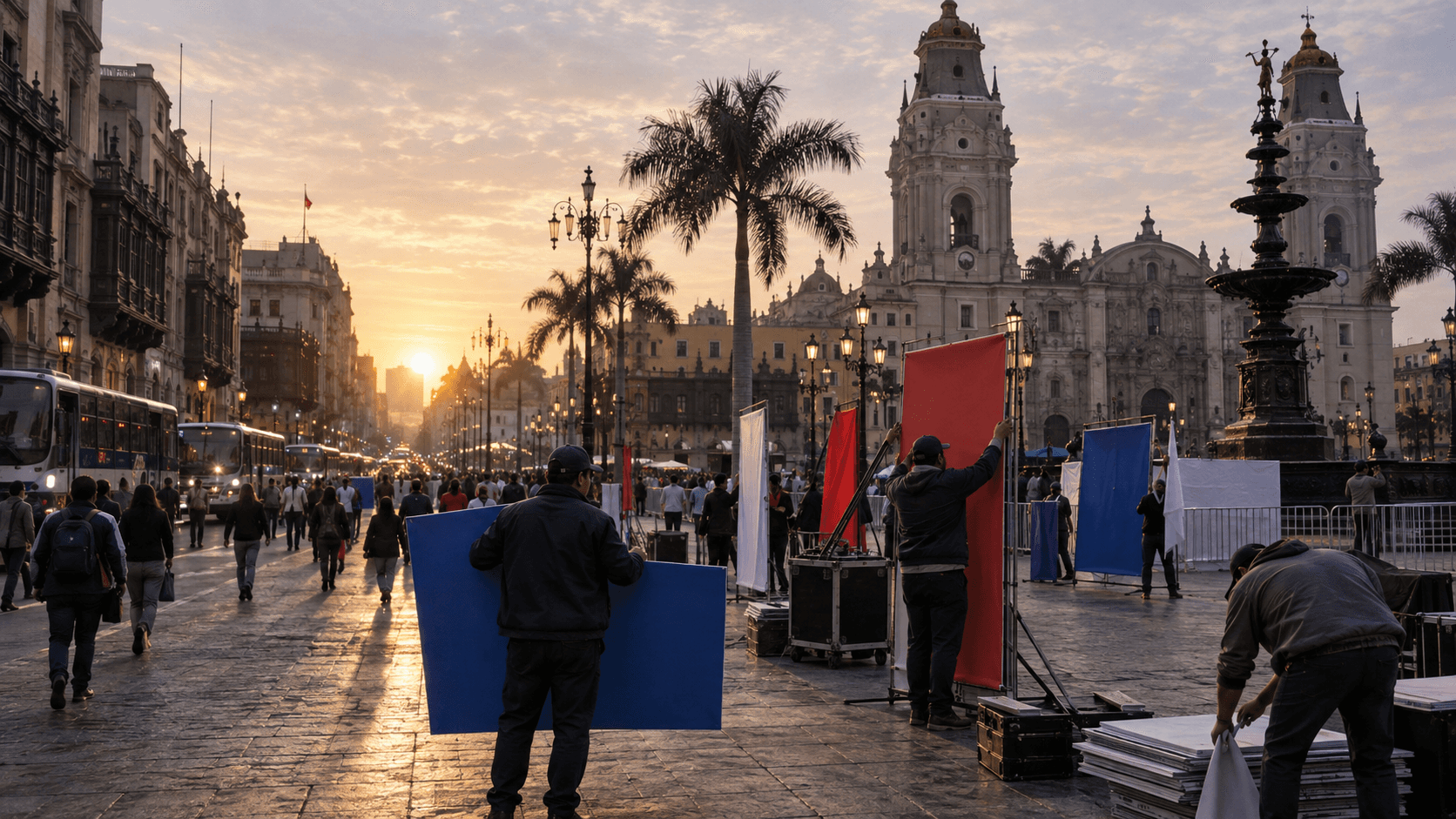
Lima’s mayoral election has become a tighter two-man contest with three weeks left before voters choose the leader of one of Latin America’s largest cities. Rafael López Aliaga remains ahead, but Carlos Bruce has consolidated second place after a late-summer campaign shaped by public safety, transport and the capital’s uneven delivery of basic services. The movement matters beyond city hall: Lima concentrates roughly a third of Peru’s population and an even larger share of its economic activity, making its municipal government a national political platform. Bruce, the mayor of the Surco district and a former housing minister, is trying to turn executive experience into a citywide case for change. A close result would also shape the balance among Peru’s established parties after a turbulent national election year.
An IMASOLU survey published September 3 put López Aliaga at 19.83% and Bruce at 16.17%, with Daniel Urresti third at 11.33%. A separate poll reported by El Comercio in August also placed the pair first and second, at 16% and 13%, respectively. The figures are not directly interchangeable because the studies used different fieldwork and methods, but both depict a fragmented race in which no candidate commands anything close to a majority. Bruce’s support has been strongest in parts of modern, central and southern Lima, while López Aliaga has retained the broadest overall base. That leaves the remaining campaign unusually sensitive to turnout, undecided voters and any shift among lower-ranked candidates.
Prediction-market traders have reacted sharply to that narrowing field. A Polymarket contract tied to a Bruce victory stood at about 30% on Sunday morning, up roughly 22 percentage points over the previous day. López Aliaga still carried about a 66% implied chance, while every other named candidate was in the low single digits. Those prices are estimates made by traders, not polling averages or election forecasts, and the market is modest compared with major national contests. Even so, the abrupt repricing reflects a race increasingly viewed as competitive between two recognizable municipal figures.
The October 4 vote will decide whether López Aliaga’s political organization keeps control of metropolitan Lima or Bruce converts his district record into a broader coalition. The next stretch of campaigning will test which candidate can speak most credibly about crime, traffic and the gap between wealthier neighborhoods and the city’s underserved outskirts. Polling also suggests that a large share of voters remains weakly attached or undecided, leaving room for late movement that prediction prices may exaggerate in either direction. Debates and neighborhood events will matter because many voters know the candidates but remain unconvinced by their citywide plans. For Bruce, the task is to turn second place into a clear alternative without losing support to the crowded field. For López Aliaga, it is to protect a lead that now looks meaningful but far from secure.