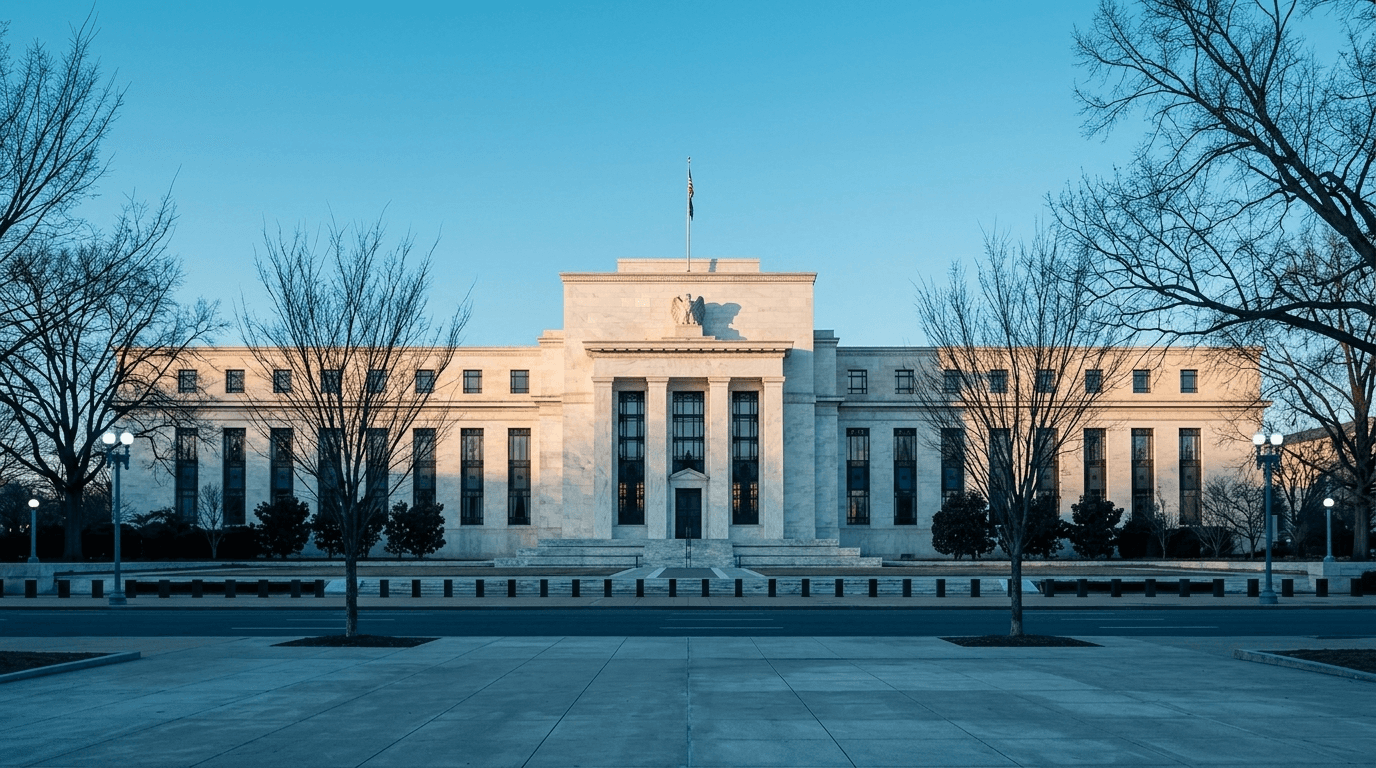
Prediction markets on Kalshi assign a 33 percent probability that the Federal Reserve will raise the federal funds rate by 25 basis points at its December 2027 meeting, reflecting sharp disagreement among economists about whether the central bank's next move will be a cut or a hike. The market probability dropped 45 percentage points in the past 24 hours on light volume of $13, underscoring how rapidly trader sentiment can shift with incoming economic data.
Goldman Sachs Research now expects the Fed to hold rates steady through all of 2026 before delivering 25 basis point cuts in June and December 2027, bringing the target range down to 3.0–3.25 percent from the current 3.5–3.75 percent. A Bloomberg survey of 35 economists echoes that timeline, with a median forecast calling for cuts in June and December 2027. Both projections assume inflation will continue to moderate and labor markets will cool enough to justify easing monetary policy in the second half of next year.
Yet J.P. Morgan Global Research takes the opposite view, forecasting that the Fed's next move will be a 25 basis point hike in September 2027, with risks tilted toward an even earlier increase. The bank sees no rate cuts in 2026 and expects persistent inflation pressures to force the central bank back into tightening mode before any easing cycle begins. Market commentary citing CME FedWatch probabilities has noted that futures traders recently priced a rising chance of hikes in early 2027, with one widely circulated note from The Kobeissi Letter asserting a 51 percent probability of a hike by March 2027 and no cuts expected until December 2027.
The divergence between consensus economist forecasts and futures-based probabilities highlights the path-dependent nature of Fed policy in 2027. If inflation proves stickier than expected or growth accelerates, the central bank could pivot toward tightening even as baseline forecasts call for cuts. The Kalshi market closes on December 8, 2027, giving traders 17 months to reassess as employment reports, CPI prints, and Fed communications reshape expectations for the terminal rate.