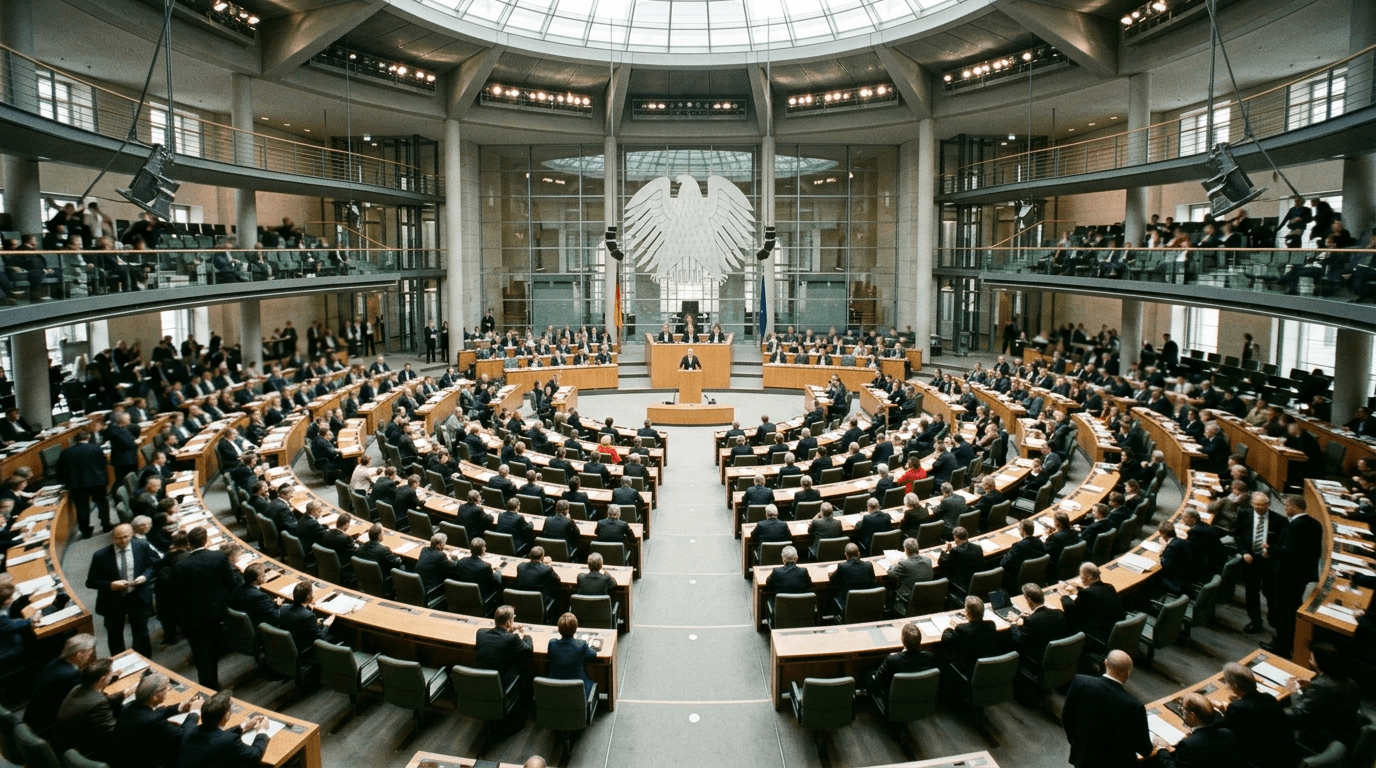
Germany’s next chancellor will not be chosen simply by whoever leads the polls. The Bundestag elects the chancellor, so the result of the next federal election will be followed by coalition negotiations that determine who can command parliamentary support. That makes the shape of a governing majority—not just which party finishes first—central to who leads Germany. The distinction is important because a party’s standing in polling does not by itself establish that it can form a government or secure the votes needed to elect a chancellor.
An INSA poll reported by Il Politico put the AfD ahead of the CDU/CSU, while the article said other pollsters had also placed the AfD first. But a polling lead is not a government. The same report said the CDU rules out cooperation with the AfD, despite a projected combined majority of 333 seats for the two parties. The poll and the reported position leave a basic political question unresolved: which parties will be willing and able to assemble a governing coalition after the election? A snapshot of polling cannot establish the answer, and the reported refusal to cooperate does not itself identify an alternative coalition.
Kalshi traders put Alice Weidel at 26% to become chancellor, as of 8:23 a.m. ET on Nov. 16. Her price was down 13 points over the week, with 209 contracts traded over the last day. Friedrich Merz was at 20%, after up 5 points over the week; no contracts traded on that outcome over the last day. These prices capture a changing market view, not a settled reading of who will govern. The recent activity differs between the two outcomes: the Weidel contract had trading, while the Merz contract had none over the last day. That makes it important not to treat the displayed prices as equally supported by current trading.
The wider stakes extend beyond the contest for the chancellery. The European Council on Foreign Relations argues that the AfD could shape Germany’s policy direction even without taking power, while explicitly describing its analysis as a scenario rather than a prediction. The possibility of influence without entering government means the question is not only whether the AfD leads a poll or holds the chancellery. Its role in shaping policy is a separate consideration, as are the coalition’s composition and the identity of the next chancellor. None of those outcomes is settled by the polling snapshot or by a market price.
Merz was still chancellor in November and described difficult coalition talks while pointing to legislation his government had advanced. His account underscores that coalition-building is part of governing, but it does not settle who will lead the next government. Germany’s next election and the parliamentary negotiations that follow will determine which candidate can secure support in the Bundestag. Until those choices are made, a polling lead, a party’s stated position and traders’ changing views each offer only part of the picture. The central uncertainty remains who can win enough parliamentary backing to become chancellor, and what coalition can sustain that support.