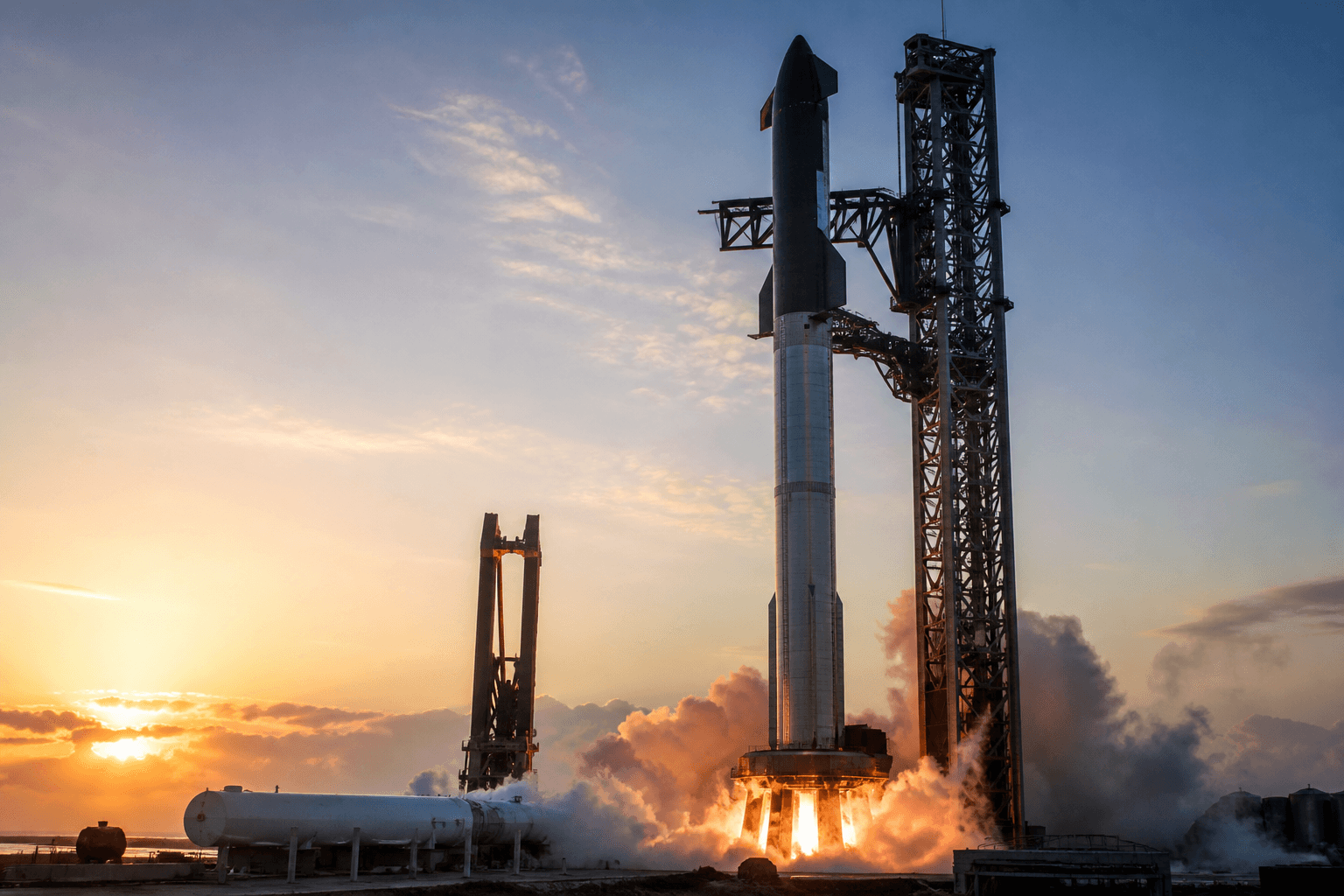
SpaceX has moved its next Starship campaign closer to flight without fully settling the launch date. Space.com reported on August 29 that the company completed a full-duration static fire of Super Heavy's thirty-three Raptor engines at Starbase, a major systems check ahead of the next integrated mission. The same report said the flight is expected to target Starship's first orbital mission, a step beyond the partial trajectories that have defined the program's recent tests. That matters because the company is no longer just proving it can light engines and leave the pad. It is trying to show that Starship can hold together through a mission profile that begins to resemble the one SpaceX ultimately wants for satellite deployment, deep-space logistics and NASA lunar work.
The recent recovery effort from the previous mission makes that push look more coherent. Space.com reported on August 27 that SpaceX had loaded the spacecraft from Flight Thirteen onto a large recovery ship in the Indian Ocean after the test's successful splashdown. That is not a public launch date, but it is evidence that the company is closing the loop between one mission and the next instead of treating each test as a disconnected spectacle. Salvage, inspection and data review are central to whether Starship can evolve into a repeatable transport system, especially if SpaceX wants regulators and customers to view the program as a fast-learning launch platform rather than an open-ended engineering experiment.
The remaining friction is official, not theatrical. The Federal Aviation Administration's Starship stakeholder page remains the clearest public reminder that every launch campaign still depends on license terms, environmental findings and the safety envelope around Starbase operations. SpaceX can stack hardware, fire engines and refine mission goals, but it still has to clear the federal process that governs when the next attempt can actually leave Texas. That is why visible technical progress can coexist with a slipping calendar. The company appears closer to a meaningful test, yet the exact moment of liftoff is still constrained by paperwork, reviews and the ordinary unpredictability of a program that keeps stretching its ambitions with each mission.
Polymarket now captures that split more clearly than the headline countdown does. On the provider's Starship Flight Test market on August 31, the October launch leg traded near 96 percent, the successful splashdown contract sat around 86 percent, and the event showed roughly $424,000 in volume. Traders are therefore not pricing a cancellation story. They are pricing a schedule that has moved out of August while leaving confidence high that SpaceX will keep pressing toward a more complete demonstration this fall. The practical question is no longer whether another Starship attempt is coming soon. It is whether the company can turn fresh booster tests and recovery lessons into an orbital mission that looks less like a dramatic prototype run and more like the beginning of routine heavy-lift operations.