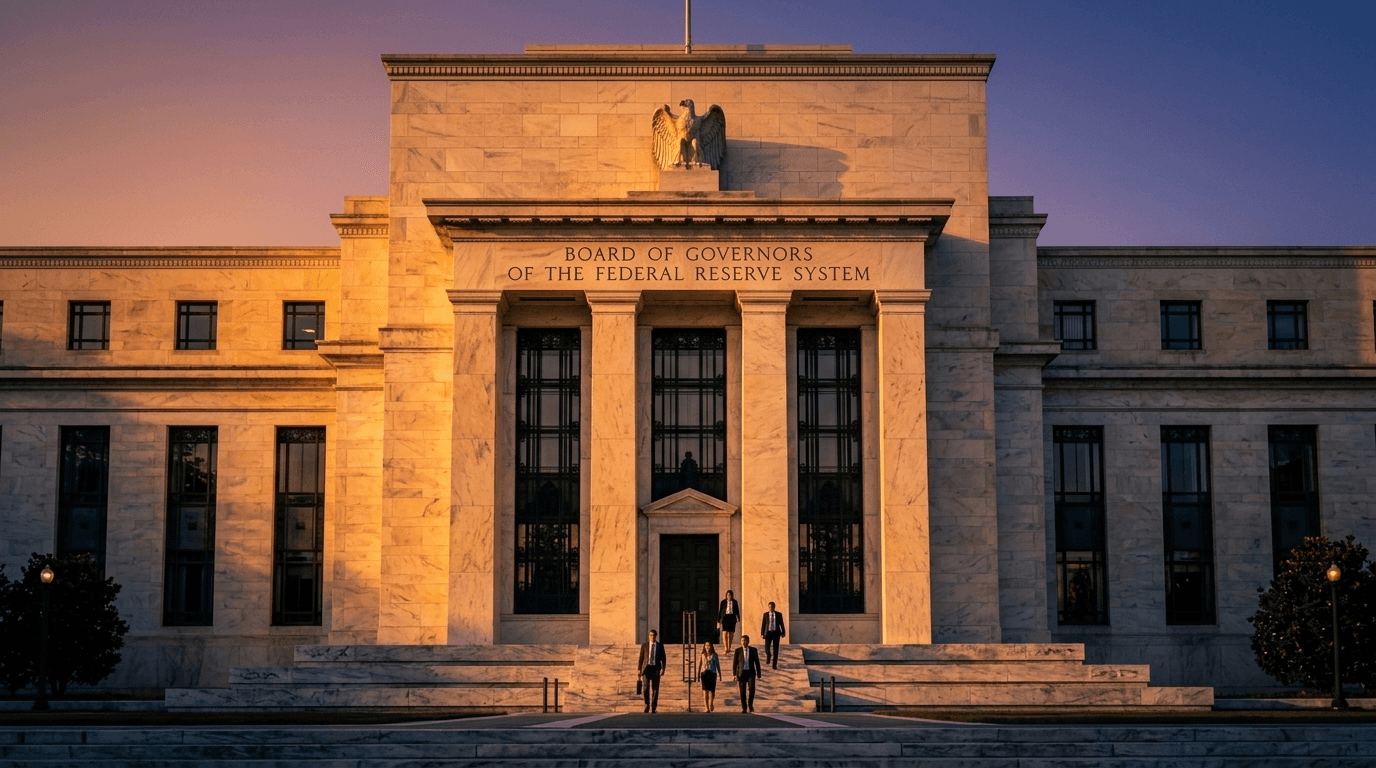
Prediction markets on Polymarket now assign a 71 percent probability that the Federal Reserve will raise its benchmark interest rate at least once before the end of 2026, a sharp departure from the consensus view among professional forecasters. The market moved 4 percentage points higher in the past 24 hours on volume of $124,433, reflecting growing trader conviction that the central bank will reverse course after 18 months of rate cuts. The Federal Reserve's benchmark federal funds rate currently stands in a target range of 3.5 to 3.75 percent, down 75 basis points since late 2025 and 175 basis points since the cutting cycle began in 2024.
The hawkish shift in market pricing follows the Federal Reserve's June 2026 meeting, where policymakers under new Chair Kevin Warsh voted unanimously to hold rates steady and removed prior forward guidance that leaned toward future cuts. The June dot plot raised the median expected federal funds rate at year-end 2026 to approximately 3.8 percent, up from 3.4 percent in March, implying at least one rate increase is now projected by most Fed officials. Minutes from the January 2026 meeting showed several participants explicitly supported language noting that upward adjustments to the target range could be appropriate if inflation remains above target.
Yet a June Reuters poll found that over three-quarters of surveyed economists expect the Fed to keep rates steady for the remainder of 2026, defying the market-implied odds of two hikes this year. Interest-rate futures recently priced a 43 percent chance of tighter policy as early as 2026 and a 64 percent likelihood of a hike by July 2027, reflecting concern about upside inflation risks tied to geopolitical tensions. Business Insider reported in May that the priced-in probability of at least one 2026 hike jumped from zero to 10 percent immediately after Chair Warsh's press conference, highlighting a sharp reassessment by investors.
Analysts including Oxford Economics' Bernard Yaros still view a 2026 rate increase as very unlikely and expect additional cuts, underscoring the divergence between prediction-market traders and many professional forecasts. The gap mirrors historical episodes such as 2018 to 2019, when markets priced more easing than the Fed's projections and the central bank ultimately pivoted in response to incoming data rather than its earlier guidance.