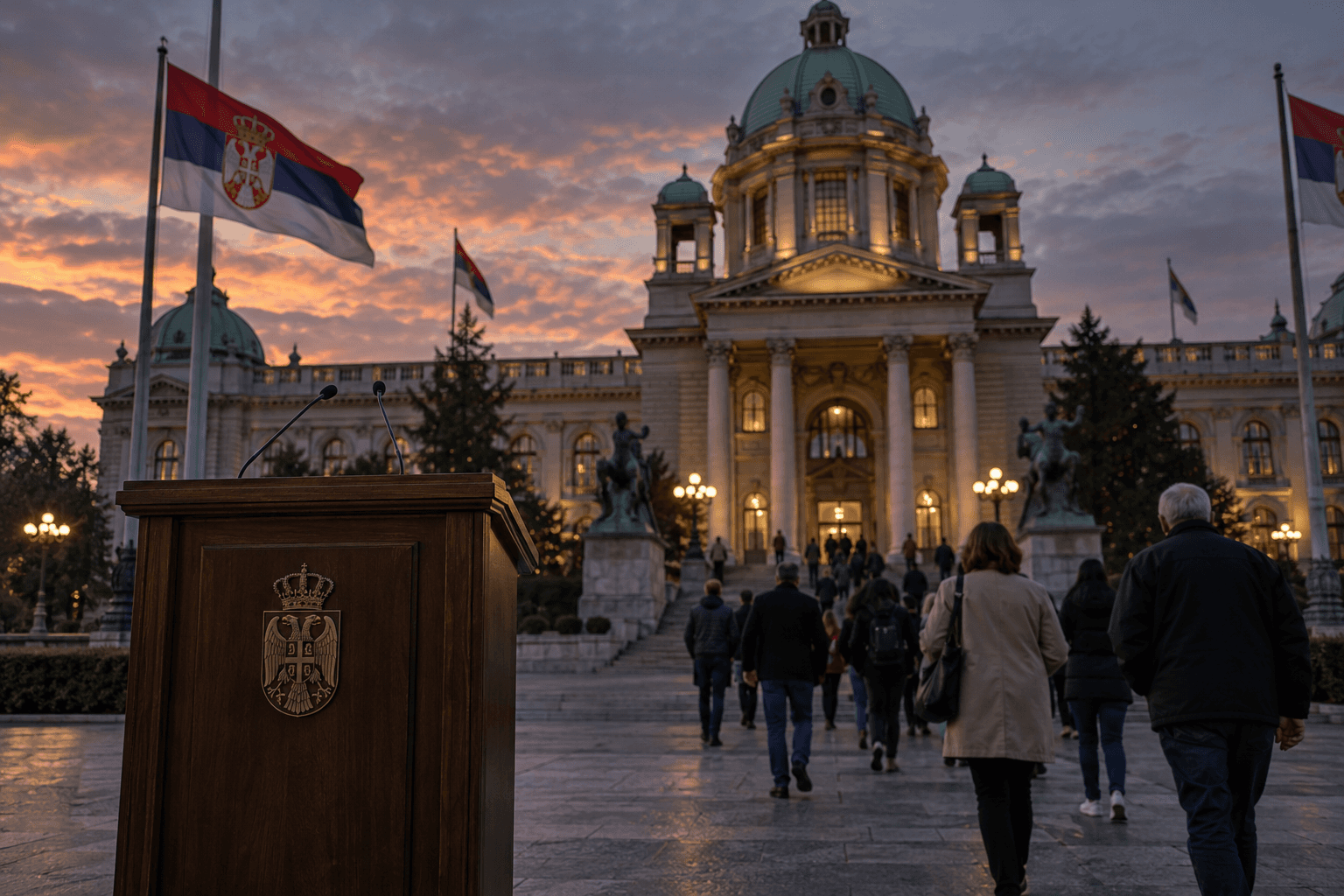
Aleksandar Vučić’s resignation as Serbia’s president has transformed an already consequential early parliamentary election into a direct test of whether he can preserve power from the prime minister’s office. Vučić stepped down on September 27 and said he would lead the Serbian Progressive Party into the October 25 vote. His presidential term had been due to end next year, and the constitution barred him from seeking a third term. By moving now, he is attempting to convert personal support built over more than a decade into another governing mandate.
The election was called after nearly two years of demonstrations that began with the collapse of a railway-station canopy in Novi Sad in November 2024, killing sixteen people. Student organizers turned demands for accountability into a broader campaign against corruption and the concentration of political power. The government dissolved Parliament in September, saying an early vote was needed to resolve deep divisions. Vučić’s resignation raises the stakes further because a defeat for his party could end the governing system he has dominated, while a victory could return him to the formally powerful premiership.
The transition also creates an unusual institutional sequence. Serbia must choose a new president within the constitutional period triggered by the resignation, while the parliamentary ballot will determine who can assemble a cabinet. Ana Brnabić, the outgoing parliamentary speaker and a senior ally of Vučić, is serving as acting president. The opposition remains diverse, but the youth-backed movement has given otherwise fragmented critics a common cause. Its challenge will be turning street mobilization into votes and then into a coalition capable of governing.
Prediction-market traders currently place Vučić well ahead in the contest to become the next prime minister. A Polymarket contract assigns him about a sixty-seven percent chance, compared with roughly twenty-four percent for Ilija Srdanović, after about $28,000 in activity across the event during the previous day. Vučić’s price rose about two percentage points in that period. The figures capture expectations about government formation after the election, not a vote forecast, and Serbia’s coalition arithmetic could still separate the largest party from the person who ultimately leads the cabinet.
The next three weeks will show whether the resignation is viewed as renewal or maneuver. Vučić will campaign as an experienced leader promising stability, while opponents will argue that changing offices would preserve the same concentration of authority. Observers will watch access to media, pressure on public institutions and the administration of both the parliamentary and presidential contests. The decisive real-world questions are whether the student movement can sustain turnout beyond the streets and whether opposition parties can cooperate after the ballots are counted. Serbia’s vote is therefore not simply about a new prime minister; it is about whether a long-dominant political order can reconstitute itself under a different title.